

The Infrastructure Behind National Power
Power is usually described in hardware. We measure it in aircraft carriers, semiconductor capacity, trade volumes, satellite networks, and budget tables. We point to ports, pipelines, stock exchanges, special economic zones, and missile ranges. When nations want to look strong, they put steel on parade and statistics on screens.
But the deepest source of national capability is harder to photograph.
It begins in places that rarely look dramatic: a primary school where children learn to read with confidence, a technical institute where students learn to troubleshoot machinery, a university lab where researchers test ideas that may fail ten times before one works, a training college where future civil servants learn how to make decisions that affect millions. These spaces do not announce themselves as instruments of state power. Yet they are exactly that. Before a nation can direct resources, enforce policy, innovate at scale, or respond intelligently to crisis, it has to build people who know how to think, learn and adapt. That is the long road from classrooms to command.
It is also one of the most misunderstood relationships in public life. Education is often discussed as a social good, an individual opportunity or a moral obligation. It is all of those things. But it is also something more strategic. Learning is the hidden infrastructure of national strength. It shapes whether a country can turn ambition into competence and potential into performance. Nations do not become capable simply because they are rich, large or well-armed. They become capable when they can organize knowledge, train judgment and improve institutions over time. In other words, what a country teaches eventually becomes what a country can do.
This process is slower than an election cycle and less visible than a military procurement, which is one reason it is so often neglected. Politicians can announce new factories and defence deals with immediate effect. The benefits of education, by contrast, accumulate quietly. A child taught to reason clearly does not transform a nation overnight. But twenty years later, that child may be designing infrastructure, managing emergency response, building software, leading a research team, negotiating a treaty or commanding troops in a moment of uncertainty. The national consequences of learning arrive gradually, then all at once.
History offers this lesson repeatedly. States that modernized successfully rarely did so through extraction or force alone. They built schools, technical training systems, research institutions and professional bureaucracies. They created pipelines through which knowledge could move into industry, government and defence. They understood that literacy was not just a cultural achievement but an administrative one; that engineering education was not just academic but industrial; that scientific research was not just prestigious but strategic. Modern power requirs more than resources. It requires people able to use them well. This is easy to say and harder to build.
Not every expansion of education produces real capability. Some systems generate certificates without competence. Others reward memorization while punishing curiosity. Some produce brilliant graduates who then enter institutions too corrupt, too rigid or too weak to make use of their abilities. A country can boast rising university enrollment and still remain administratively fragile. It can build campuses and remain intellectually shallow. Learning matters, but only when it is genuine, broadly distributed and is connected to systems that know how to absorb it.
National capability is not the same thing as educational attainment. It is what happens when learning becomes usable. Wealth in the modern world depends less on raw labor and more on skilled adaptation. The countries that thrive are not merely those that manufacture, but those that can redesign, retool, retrain and invent. In an age shaped by automation, artificial intelligence and digitization, the premium no longer rests mainly on routine output. It rests on problem-solving capacity. A society that can continuously learn can shift industries, absorb shocks and move into higher-value sectors. A society that cannot will remain dependent on ideas, systems and expertise developed elsewhere.
This is why education is not just about preparing people for jobs. It is about preparing an economy for change. Governments today face problems that are technical, fast-moving, and interconnected. Public health cannot be separated from logistics, trust and data as seen during COVID times. Climate policy cannot be separated from finance, infrastructure and regional inequality. Security is no longer confined to borders; it runs through code, energy systems, information flows, and fragile supply networks. These are not problems that yield to authority alone. They demand institutions able to interpret evidence, coordinate action and revise assumptions when reality shifts.
A capable government is, at heart, a learning government. It means a state that can collect information without distorting it, promote expertise without fearing it and correct mistakes without collapsing into denial. Such qualities do not begin in cabinet rooms. They are rooted earlier, in the intellectual habits a society teaches and rewards. If schools train people to recite rather than question, if universities produce conformity rather than rigor, if professional advancement depends on loyalty more than competence, those patterns tend to echo upward into public institutions.
There is also a civic dimension that is too often overlooked. National capability is not only about what governments can command; it is about what societies can sustain. A country under stress depends on more than policy tools. It depends on social trust, public reasoning, and the ability of citizens to process conflict without turning every disagreement into institutional paralysis. Education helps shape those habits early. It is one of the first places where people encounter rules beyond the family, difference beyond the familiar and argument beyond impulse.
Done well, education does not merely transmit information. It teaches people how to live with complexity. It really matters in democratic life, where citizenship requires more than opinion. It requires judgment. It requires the ability to separate evidence from performance, disagreement from disloyalty and persuasion from manipulation. In a polluted information environment, these are not abstract virtues. They are forms of resilience. A population trained only to react is easily divided. A population trained to think has a better chance of staying governable without becoming submissive.
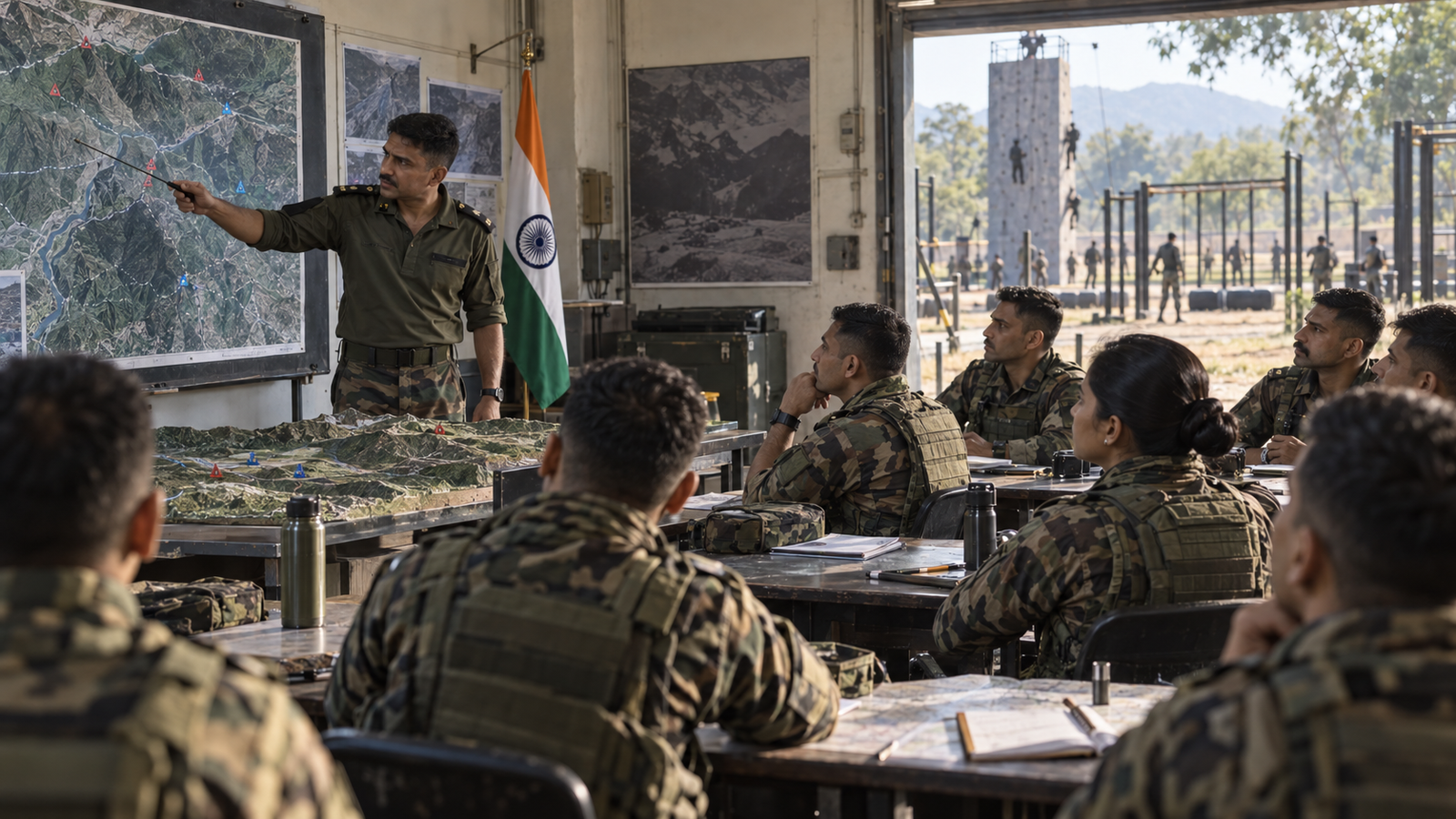
The military sphere reinforces the same point. No institution seems farther from the classroom than command and yet modern armed forces depend profoundly on education. Advanced militaries require technical skill, doctrinal flexibility, ethical training, historical understanding and the capacity to make decisions in conditions where information is incomplete and consequences are immediate. Even though the equipment matters, but anyone who studies war knows that the side with better tools does not always prevail. The side that learns faster often does. Armies, like nations, fail when they stop learning. They fail when hierarchy becomes a substitute for thought, when outdated assumptions go unchallenged, when lessons from the field do not travel upward, and when professional education is treated as ceremonial rather than essential. Strategic competence is not simply about command authority. It is about trained judgment under pressure. And that kind of judgment is never improvised. It is cultivated.
For a the above reasons, the phrase “from classrooms to command” deserves to be taken literally. The journey is not symbolic. It describes the actual movement through which individual learning becomes collective power. The child who learns to read well gains more than a skill. The state gains a future worker, voter, analyst and decision-maker. The student trained in mathematics may later solve engineering problems that strengthen national infrastructure. The young researcher may help build a domestic innovation base. The well-taught recruit may become an officer capable of acting wisely under pressure. The public servant educated in law, statistics and ethics may keep an institution from drifting into dysfunction.
National capability is built person by person, habit by habit, classroom by classroom. Schools alone cannot save a country from corruption, poor leadership or structural inequality. Talent can be wasted. Institutions can be hollow. Brilliant people can leave. But without learning, none of the other pillars of national strength can hold for long.
The strongest nations are not simply those that can project force or accumulate wealth in one decade. They are the ones that can renew themselves in the next. They can train new experts, absorb new technologies, recover from mistakes and respond to shocks without losing coherence. They can change course because they know how to think, not merely how to insist. This kind of strength begins with patient investment in minds, institutions and the public habits that allow all to grow. It begins in ordinary rooms with fluorescent lights, whiteboards, worn desks, lab benches and overworked teachers. It begins where societies decide, quietly or not, what kind of people they want to become.
Before a nation can command the future, it must first learn how to prepare for it. And that work, more often than not, starts in the classroom.
About the Author
Mr Shailesh Kumar
Indian Air Force (Veteran) · Banking Professional
Mr Shailesh Kumar served with distinction in the Indian Air Force for two decades, navigating diverse responsibilities across some of the country’s most challenging and varied terrains. His 20-year military career instilled in him a deep sense of discipline, resilience, and a profound understanding of human nature under pressure—themes that subtly enrich his writing.
Following his honourable transition from defence service, he brought his leadership and analytical acumen to the civilian sector and is currently managing key responsibilities at a national level bank.