
Table of Contents

Research proves its worth not in citations but in real-world impact. My work in environmental engineering — from anaerobic wastewater reactors to microalgal biotechnology — has been guided by one goal: turning laboratory insight into deployable solutions for wastewater treatment, carbon capture, and the circular bioeconomy.
From Wastewater Studies to Microalgae
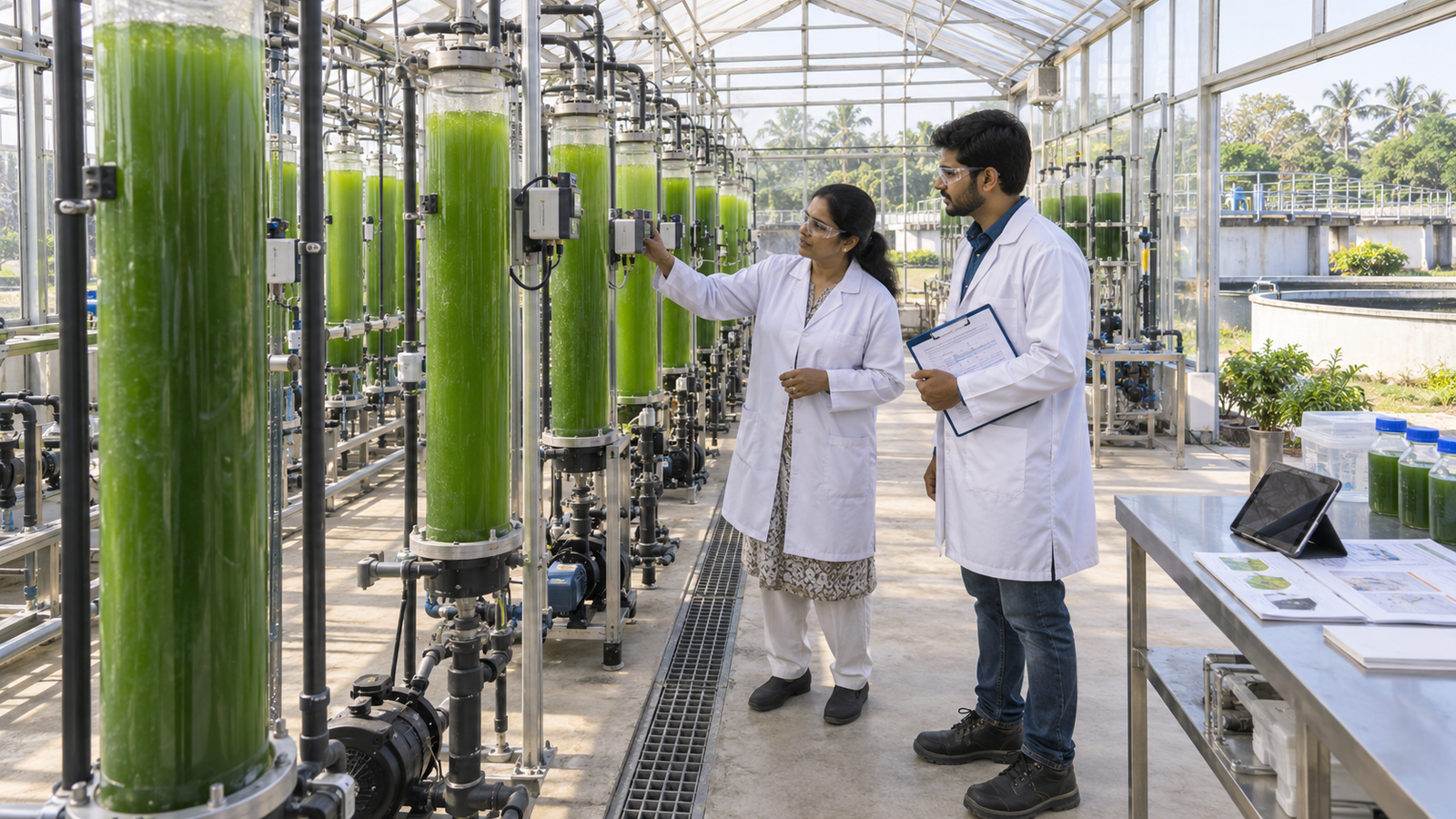
Early work on anaerobic baffled reactors treating landfill leachate revealed a guiding principle: reactor design decides how well biological systems perform. That insight carried into microalgal biotechnology — organisms that capture CO₂, strip pollutants from wastewater, and yield biofuels, biofertilizers, and pharmaceuticals, all at once. Testing strains like Chlorella vulgaris and Galdieria sulphuraria across municipal, industrial, and pharmaceutical wastewaters confirmed the same lesson: reactor design, not biology, was the real bottleneck — conventional ponds and photobioreactors suffer from self-shading, poor CO₂ transfer, and scale-up failures.
CFD simulations paired with experimental testing showed that small changes in geometry, sparger placement, and lighting could transform cultivation performance — work that fed directly into designing and operating bubble column photobioreactors and pilot-scale treatment systems with industrial partners.
A Patented Solution: The Bubble Column Airlift Photobioreactor
That research converged into a novel design: six airlift-assisted cultivation vessels arranged around a central hexagonal illumination module, built to solve light attenuation, self-shading, and uneven mixing in one stroke.
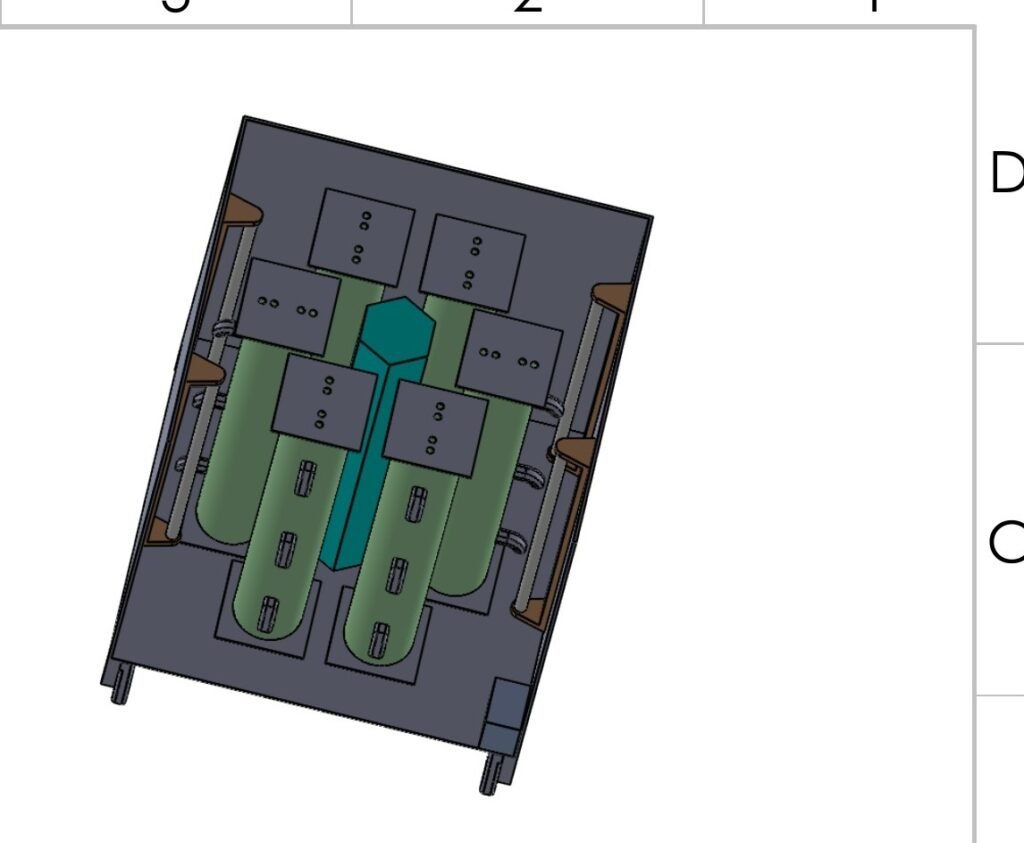
- Uniform light delivery — a central module distributes photons evenly across six chambers, improving photosynthetic efficiency.
- Low-shear airlift circulation — boosts gas-liquid mass transfer and CO₂ dissolution without damaging cells.
- Intelligent control — real-time sensors for pH, dissolved oxygen, temperature, and biomass drive automated adjustments to light, CO₂, and nutrients.
- Modular & scalable — deployable from research labs to industrial and decentralised treatment sites.
The technology has been filed as a patent through Durban University of Technology and cleared by the Government of India for international filing — proof that publications, reactor studies, and industrial experience can converge into intellectual property with tangible value.
Engineering the Advantage: Light and Hydrodynamics
Light remains photosynthesis’s biggest bottleneck in large-scale reactors — cells near the source over-expose while distant ones starve. The hexagonal module’s symmetrical layout shortens the optical path and allows each face to be independently controlled for precision cultivation.
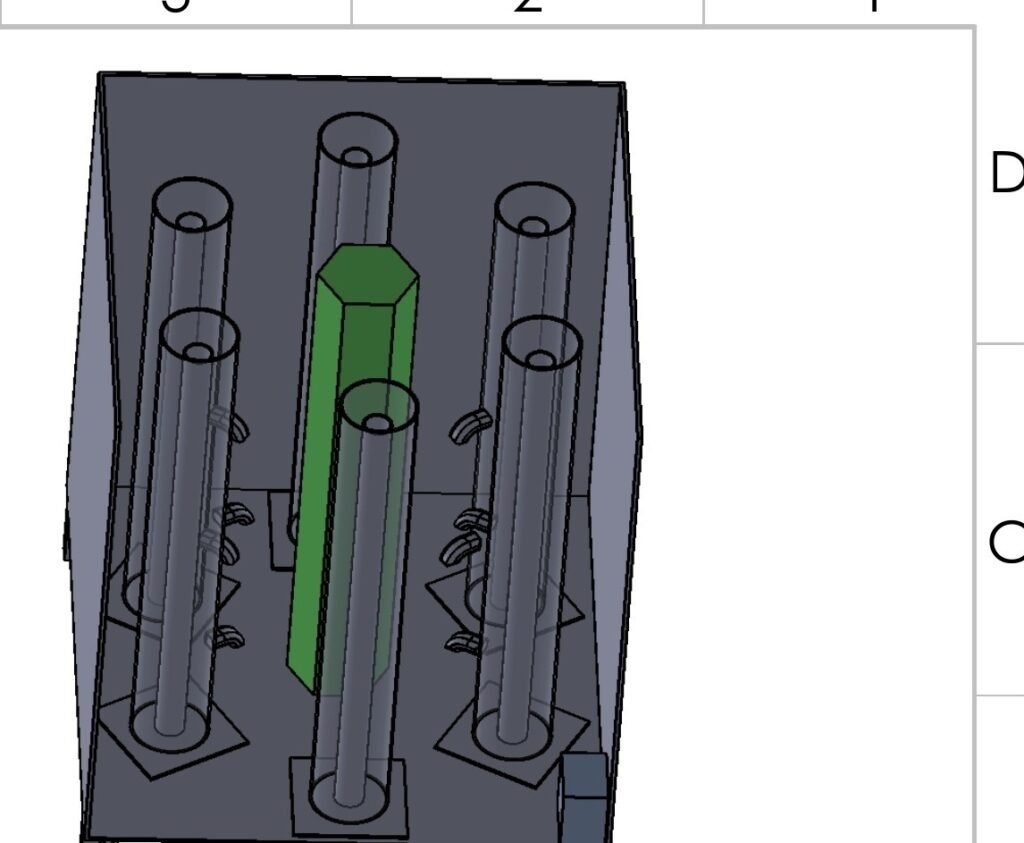
On the hydrodynamics side, airlift-assisted circulation replaces the trade-off between poor mixing (bubble columns) and cell-damaging shear (mechanical mixers), improving nutrient transport, gas exchange, and light-dark cycling together — while built-in sensors lay the groundwork for future AI-driven cultivation.
Broader Impact: Carbon, Water, and Fuel
Microalgae fix carbon far faster than terrestrial plants, turning industrial CO₂ streams into biomass rather than waste. The same reactor simultaneously treats wastewater, recovers nutrients, and captures carbon — a genuine circular-economy platform. It also positions microalgae as a serious feedstock for sustainable aviation fuel, since cultivation doesn’t compete for arable land or freshwater.
Collaboration, Mentorship & the Road Ahead
Translating lab science into deployable technology depended on sustained academia-industry collaboration and hands-on validation with real operational constraints. Alongside this, mentoring undergraduate, postgraduate, and doctoral students has been central to extending the work’s reach.
The core lesson for researchers: publications are building blocks, not destinations. Real impact comes when knowledge is translated into technologies, products, and policy — and universities must actively foster that translation through entrepreneurship and technology transfer.
This photobioreactor’s journey — from reactor studies to granted patent — shows how sustained inquiry, collaboration, and persistence turn ideas into technologies with real environmental and economic value. Research papers are starting points, not endpoints; converting knowledge into impact is what will define academic excellence going forward.
About the Author
Imran Ahmad
Postdoctoral Researcher, Institute for Water and Wastewater Technology (IWWT), Durban University of Technology (DUT)
Imran Ahmad specializes in algae biotechnology and advanced wastewater treatment for environmental sustainability and circular bioeconomy applications. He holds an MPhil and PhD from Universiti Teknologi Malaysia, with expertise in biological wastewater treatment, microalgal bioremediation, and resource valorization.
His technical strengths lie in designing and scaling up photobioreactors and anaerobic treatment systems. He previously served as Bioprocess Engineer and Scientific Consultant at PhyEcoSyS, translating lab research into industrial environmental solutions, and has contributed to international initiatives including the Indo-European Horizon 2020 PAVITR project and Liquid Trees.
He holds a utility innovation for a modified restaurant grease trap design, and his scholarly work spans high-impact journals, the My Membrane Award (Malaysia Membrane Society, UTM), recognition from Japan’s Algae Industry Incubation Consortium, and contributions to books from IWA Publishing, Springer, IGI Global, and CRC Press. With over eight years of academic experience, he has mentored students and built laboratory infrastructure across interdisciplinary collaborations.