
Table of Contents

India’s vision of Viksit Bharat 2047 is far more than an economic milestone. It is a national mission to transform knowledge into capability creating impact, research into strategic solutions, and innovation into sustainable socioeconomic growth. India today possesses one of the world’s largest and dynamic research and higher education ecosystems. Universities, national laboratories, startups, MSME’s and research institutions collectively generate thousands of indigenous innovations every year. Flagship national initiatives such as the National Education Policy, Startup India, Atmanirbhar Bharat, Digital India, the National Green Hydrogen Mission, and the Deep Ocean Mission have further strengthened the country’s innovation landscape and created unprecedented opportunities for research led development. At the heart of this transformation lies India’s greatest strength, its young demographic dividend.
While India has built one of the world’s largest higher education and research ecosystems, a critical challenge remains intact – the conversion of research outputs into commercially viable technologies, industry adoption, employment generation, societal solutions, and economic value remains limited. Bridging the gap between laboratory innovation and real world deployment is essential for maximizing the value of national investments in research and development. Equally important is the need to equip and continuously upskill the nation’s young talent with industry relevant, innovation driven, and entrepreneurial competencies. The challenge now is not the generation of knowledge, but its transformation into technologies, enterprises, and solutions that drive industrial growth, address societal needs, create employment opportunities, and enhance national competitiveness in the global knowledge economy.
As a technocrat with over sixteen years of experience spanning industry operations, mentoring, research, innovation, intellectual property, standards, environmental compliance, multidisciplinary collaborations and technology commercialization, and as an inventor with patented technologies, I have witnessed innovation from both sides of the spectrum, creating new innovation and enabling the innovation translation into real world applications. This dual perspective has reinforced my conviction and I have learned one fundamental lesson: research generates knowledge and creates inventions, but commercialization creates impact and value.
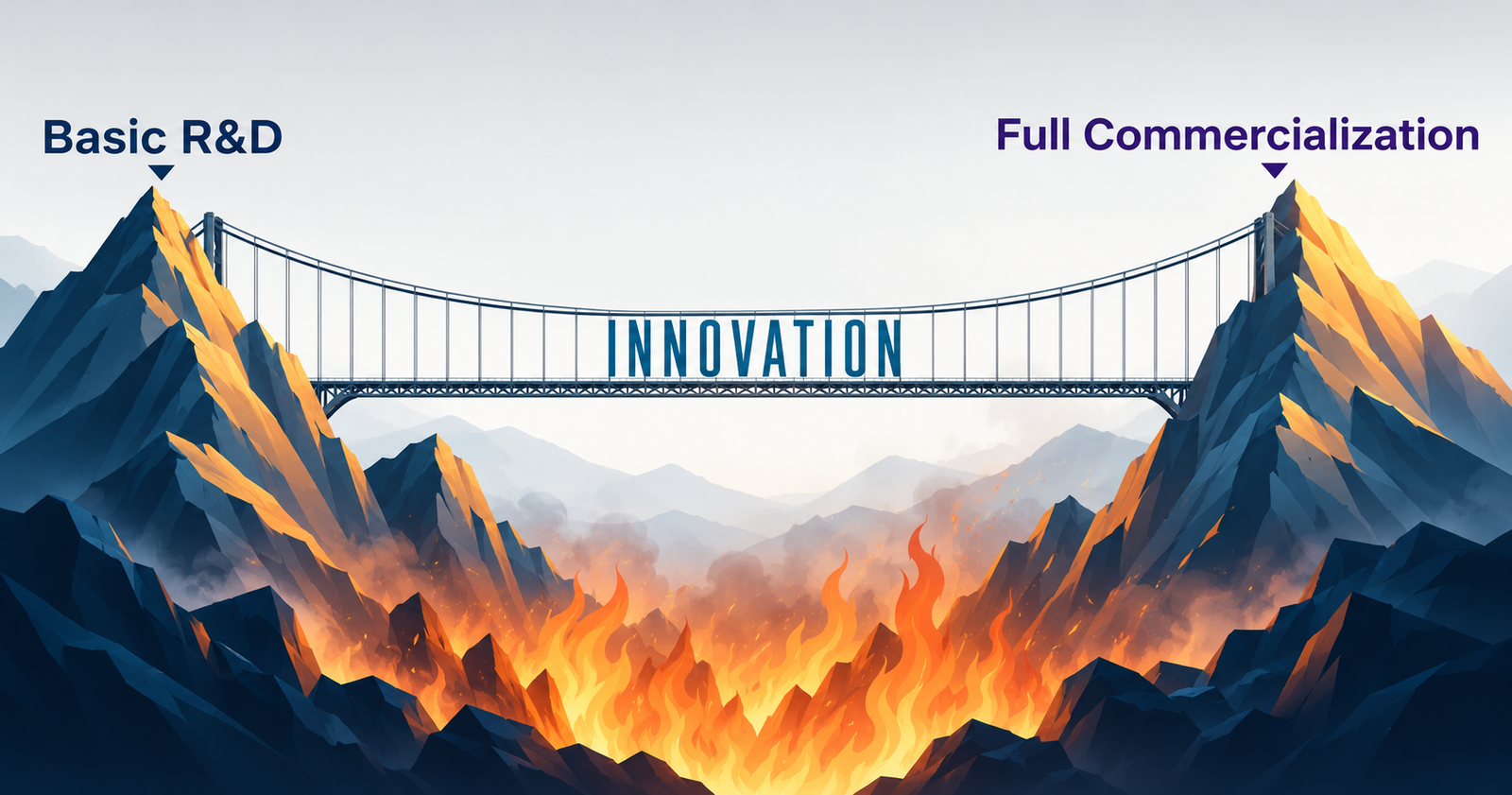
The Valley of Death in Indian Innovation
National Research Development Corporation (NRDC), established in 1953 under Ministry of Science and Technology, DSIR, Govt. of India is the country’s pioneering technology transfer and commercialization organization. For over seven decades, NRDC has played a vital role in facilitating the transformation of research and innovation into market ready technologies leading to executing more than 5100 technology transfer agreements, helping transform laboratory innovations into commercially successful products and enterprises. Landmark success stories such as Indelible Ink used in elections, Artificial Heart Valves, Amul Spray instant baby food, Herbal Sanitary Napkins, Saline Water Lantern, Remotely Operating Vehicle, Wave Powered Navigational Buoy and many more. At NRDC, while facilitating the transfer and commercialization of more than eighty technologies from leading R&D institutions, I had the opportunity to witness firsthand both the tremendous potential of Indian research and the challenges involved in translating that potential into societal value.
Promising innovations and technologies remain confined to laboratories, research papers, and prototype stages. This gap between invention and market adoption is often referred to as the “Valley of Death” in innovation. The challenge is not the lack of scientific excellence, but the ability to bridge the gap between invention and adoption. Converting research into real world solutions requires a coordinated ecosystem of IP, development strategy, standards, policy advocacy, market readiness, industry partnership, scalability, cost-effectiveness and technology commercialization.
Intellectual Property: Converting Knowledge into Strategic Assets
In the twenty first century, intellectual property has emerged as a key driver of economic growth, technological leadership, and national competitiveness.
Patents, trademarks, copyrights, industrial designs, and trade secrets are no longer legal instruments alone. They have become strategic assets capable of attracting investment, enabling collaborations, supporting technology transfer, and creating new enterprises. Through extensive engagement with startups, MSMEs, universities, and public sector organizations, it is evident that awareness regarding intellectual property has increased significantly in recent years. However, many innovators, scientists and academic scholars still perceive IP protection as the final objective rather than the beginning of the commercialization journey.
A patent acquires real value when it becomes a product, a process, a startup, or a licensed technology that generates economic and societal benefits. Technology commercialization transforms intellectual property from a legal document into an engine of development.
Technology Readiness Levels: Measuring the Commercial Journey
One of the most significant aspects of my experience has involved assessing the commercial readiness of emerging technologies and facilitating their transition from research laboratories to industry. While industries seek validated solutions with demonstrated performance, reliability, and market potential, many promising innovations remain confined to proof of concept, prototype, or pilot stages. This is where Technology Readiness Levels (TRLs) become critical.
TRL assessment and stage gate process in innovation provides a structured framework for evaluating the maturity of technologies, identifying developmental gaps, estimating resource and investment requirements, and defining the pathway toward large scale development, deployment and commercialization. TRL assessment helps researchers and innovators to understand the pathway ahead for advancing their technologies, while enabling industries, investors, and policymakers to assess risks, scalability and commercial viability. Technology readiness evaluation is not merely a technical exercise, it is a strategic and meticulous approach that determines whether a technology is ready for investment, industrial adaptability, licensing, manufacturing, and market deployment.
Market Readiness: The Missing Dimension
In addition to technology readiness, market readiness represents a vital component of the commercialization process and often determines the success of market adoption. While researchers are primarily concerned with technical feasibility and performance validation, industry stakeholders evaluate a technology through the lens of market demand, customer acceptance, regulatory compliance, competitive positioning, commercial viability and sustainable business model and its potential to serve as a disruptive innovation capable of transforming existing markets, industries, or consumer behavior. A technology may demonstrate exceptional technical merit; however, without a clearly defined market pathway and value creation strategy, its prospects for large scale adoption and commercial success remain limited.
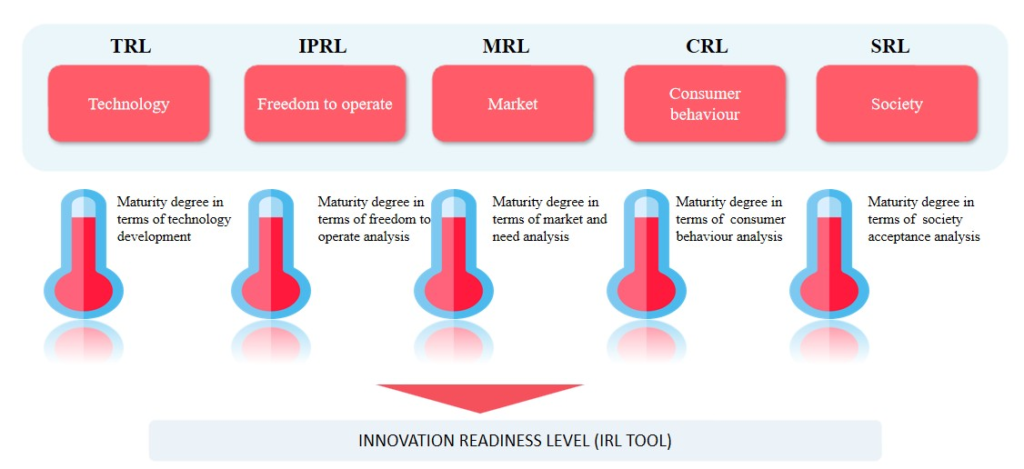
Successful technology commercialization requires a multidimensional assessment that extends beyond technology development alone. As illustrated in the framework, Technology Readiness Level (TRL) evaluates the maturity of the technology, Intellectual Property Readiness Level (IPRL) assesses freedom to operate and IP positioning at domestic and global platform, Market Readiness Level (MRL) measures market demand and commercial potential, Consumer Readiness Level (CRL) evaluates end users ease in adoption, while Societal Readiness Level (SRL) examines the broader social acceptance and impact of the innovation. Integrating these dimensions into a comprehensive Innovation Readiness Level (IRL) framework provides a comprehensive approach for identifying gaps, reducing commercialization risks, and enabling informed decisions that accelerate the successful transition of innovations from the laboratory to the marketplace and society.
Standards: The Foundation of Trust and Adoption
A technology may be innovative, protected through intellectual property, and demonstrate strong commercial potential. However, without conformity to established standards and regulatory frameworks, its large scale industrial adoption and market acceptance can remain significantly constrained. Through my interactions with industry stakeholders, scientists, standards development organizations, investors and technical committees, I have come to recognize standards as one of the most important but least appreciated pillars of innovation. Standards provide the foundation for quality, safety, interoperability, reliability, and consumer confidence, thereby accelerating the transition of technologies from laboratories to markets. As India aspires to strengthen its position as a global technology and manufacturing leader, it must move beyond being a consumer of standards and actively contribute to the development of future national and international standards. Technology leadership and standards leadership are inherently interconnected and must evolve in tandem to drive sustainable innovation and global competitiveness.
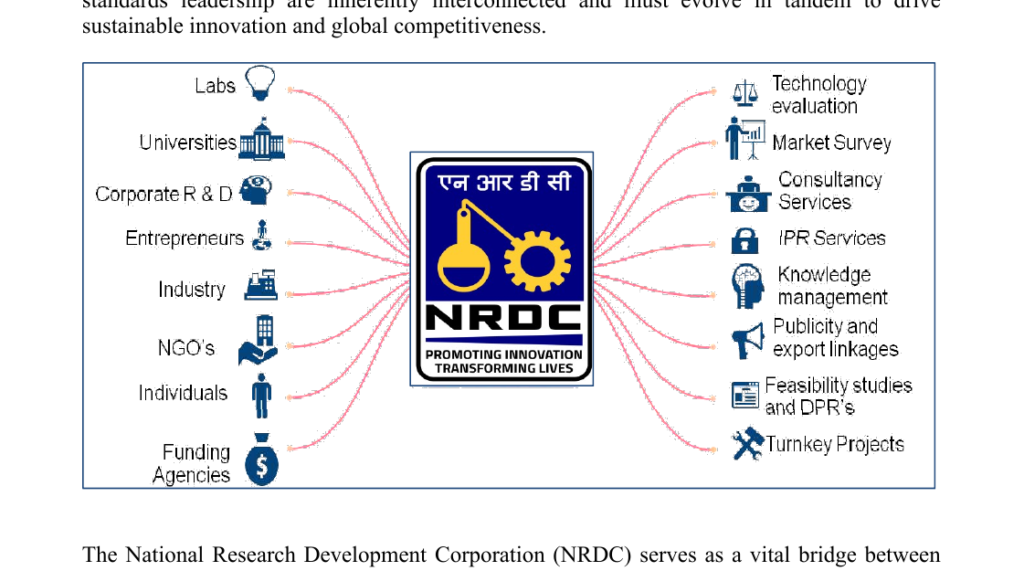
The National Research Development Corporation (NRDC) serves as a vital bridge between knowledge creators and technology users within India’s innovation ecosystem. As illustrated in the figure, by facilitating these critical linkages, NRDC plays a catalytic role in transforming research outcomes into commercially viable technologies, fostering innovation driven entrepreneurship, strengthening industrial competitiveness, and creating sustainable societal and economic impact.
From Innovation to Illumination (ROSHINI): A Global Success Story of Green Technology Commercialization
A notable example was the commercialization of the ROSHINI (Renewable Ocean System for Harnessing Novel Illumination) technology which is India’s first portable saline water lantern developed by the National Institute of Ocean Technology (NIOT) and commercialized through NRDC’s technology transfer strategy. This green technology utilizes saline water to generate clean, affordable, and sustainable lighting and mobile charging solutions, making it particularly suitable for coastal, remote, off grid, and disaster affected regions where conventional electricity access is limited. NRDC provided a comprehensive assessment covering intellectual property protection, market survey analysis, competitor analysis, technology validation, manufacturing feasibility, commercial strategy, and commercialization pathways. Detailed market research, societal impact assessment and feasibility studies were conducted to identify target users, commercialization opportunities, and potential adoption challenges before successful transfer of technology to multiple startups and MSMEs in the country.
The success of ROSHINI extended beyond national recognition. The technology was featured in the World Intellectual Property Organization (WIPO) Green Technology Book: Energy Solutions for Climate Change, launched during COP29, where it was recognized among innovative global energy technologies contributing to climate change mitigation and sustainable development. The inclusion of ROSHINI in this prestigious international Green Technology Book highlights the potential of indigenous Indian renewable innovations to address global sustainability challenges through effective intellectual property management and technology commercialization.
The ROSHINI experience demonstrates that successful innovation requires much more than scientific excellence. It requires a systematic approach involving technology readiness evaluation, market intelligence, standards compliance, intellectual property protection, industry partnerships, and commercialization support. Most importantly, it demonstrates how research originating in a laboratory can cross the Valley of Death and create measurable societal impact through strategic technology transfer and market adoption.
Conclusion
India’s journey towards Viksit Bharat 2047 will be determined not merely by the volume of research it produces, but by its ability to transform knowledge and innovation into national capability. Bridging the Valley of Death requires a holistic innovation ecosystem that integrates intellectual property protection, technology readiness assessment, market validation, standards compliance, skilled manpower, industry partnerships, and strategic commercialization. Research publications and patents are important milestones, but their true value is realized only when they evolve into products, enterprises, jobs, and solutions that address national and global challenges. Experiences such as the successful commercialization of ROSHINI technology offering an environmentally friendly energy solution, demonstrate that with the right assessment and implementation strategies, indigenous innovations can progress from laboratory stage to globally recognized technologies delivering significant social, economic, and environmental benefits.
As India strengthens its position in the global knowledge economy, it is imperative that researchers, institutions, industries, policymakers, and commercialization agencies work collaboratively to ensure that every promising innovation has a pathway to adoption. To achieve this transformation, Research must reach industries. Intellectual property must create enterprises. Standards must build trust. Technology Readiness Level (TRL) assessment must reduce commercialization risk, Market readiness evaluation must guide innovation strategy and Technology commercialization must become an integral component of the research ecosystem. The future belongs not only to nations that generate ideas, but to those that successfully translate ideas into impact. By fostering a culture that values commercialization alongside discovery, India can unlock the full potential of its scientific ecosystem and accelerate its emergence as a global innovation and technology leader.
References
- Government of India. (2023). Viksit Bharat 2047: Vision for a Developed Nation | Viksit India. https://viksitindia.com/
- National Research Development Corporation (NRDC), Department of Scientific and Industrial Research, Ministry of Science and Technology, Government of India. https://nrdcindia.com/
- NITI Aayog. (2023). Technology Commercialization Readiness Matrix (TCRM): A Framework for Assessing Commercialization Readiness of Technologies. Government of India. https://www.niti.gov.in/sites/default/files/2023-07/TCRM-Matrix-FrameworkFAD3.pdf
- Press Information Bureau, Government of India, “Saline water lantern developed by NIOT launched by Union Minister Dr. Jitendra Singh,” Aug. 13, 2022. https://www.pib.gov.in/PressReleasePage.aspx?PRID=1851483®=48&lang=2
- The Times of India, “Vizag startup set to commercialise ROSHINI,” Apr. 13, 2024. https://timesofindia.indiatimes.com/city/visakhapatnam/vizag-startup-set-tocommercialise-roshini/articleshow/109259345.cms
- Livelihood Alternatives, “Tripartite License Agreement,” Nov. 11, 2024. https://www.livelihoodalternatives.com/events/tripartite-license-agreement
- World Intellectual Property Organization (WIPO), Green Technology Book: Energy Solutions for Climate Change. Geneva, Switzerland, 2024. https://www.wipo.int/web/green-technology-book
- AUTHOR LINKEDIN PROFILE: https://www.linkedin.com/in/dr-bhavya-manjeera-patruni-a68061232/
About the Author
Dr. Bhavya Manjeera Patruni
National Research Development Corporation
[An Enterprise of DSIR, Min. of Science & Technology, GoI]Dr. Bhavya is an experienced professional with PhD (doctorate) in Chemical Engineering with a Verified International Academic Qualifications by World Education Services 5365360IMM and attained International PG Diploma in IPR management on “Fostering Innovations and IP Commercialization” sponsored by Ministry of Foreign affairs from Copenhagen Business School, Denmark. She is having more than 16 years of hands-on experience in Industrial Operations & Optimization, Research and development, Evaluating, Validating, Mentoring, Protecting, Managing and Commercializing technologies developed in India in sectors like mineral processing, chemical, marine, batteries, fuel cells, energy, waste to wealth, medical and health care technologies developed by R&D institutes and industries. Successfully commercialized more than 85 technologies from 2017-2026. She comprises experience in mentoring and managing incubation cells, start-up ecosystem, MSME’s and research institutes. She is mentoring various projects sponsored by Ministry of Heavy Industries, Ministry of Defense, Ministry of Science & Technology, Ministry of Earth Sciences, and Ministry of Steel, Govt. of India. Experienced in prototype development, IP valuation, commercial upscaling of TRL & IRL by technologies evaluation and market survey analysis. Extended services to facilitate technology evaluation and patent filing of the MATSYA 6000 technology indigenously developed by National Institute of Ocean Technology (NIOT). She works with a unique synergy playing a pivotal role in advancing STEM agendas and SDG Goals aligning to the mandate of MoST.
She executed interdisciplinary collaborations and bilateral agreements with international organizations like European Business and Technology Centre (EBTC), WIPO Green-Geneva, United States under Secretary of Commerce for Intellectual Property (USPTO), Danish Patent and Trademark Office (DKPTO) to name a few. She is serving as a Principle member in Electro Technical Division 54-Marine Energy Conversion Systems, Bureau of Indian Standards (BIS) and the committee member of International Electro-technical Commission (IEC) TC 114 (International standards Committee). She is serving as Board of Studies member and advisory in various higher educational institutions.