


Dr. Eytan Ellenberg
Head of Research & Academy, National Institute of Israel, Founder FAIR Research Organisation
Is Rewriting India’s Clean-Air Policy
Knowing a sector’s contribution to PM₂.₅ concentration is not the same as knowing its contribution to mortality. FAIR closes that gap — and in doing so, offers India a precision roadmap from blunt averages to lives actually saved.
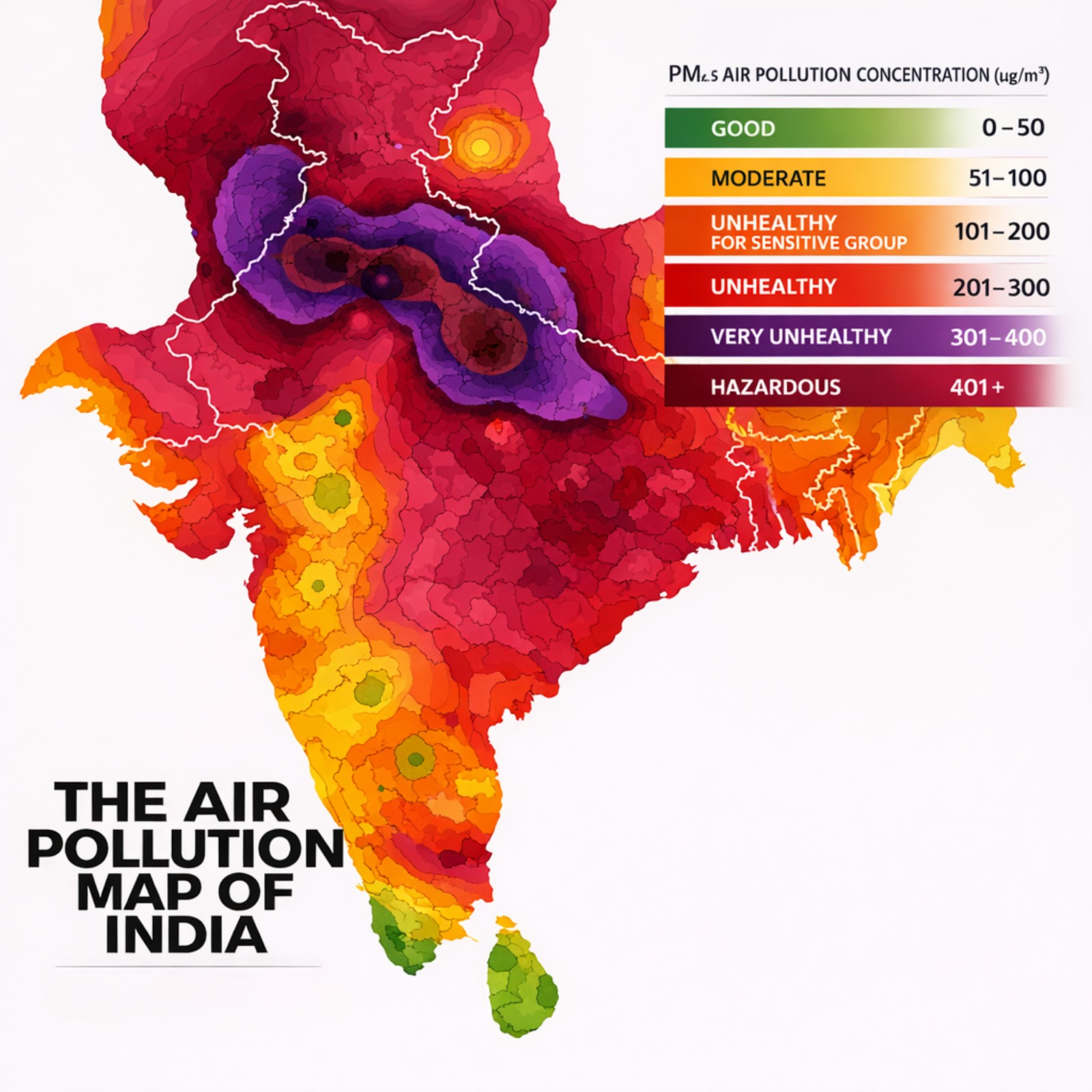
India is at a decisive crossroads where rapid economic growth, urbanisation, and the energy transition are colliding with environmental limits, particularly urban air pollution. From Delhi to Mumbai, and from Kolkata to Varanasi, concentrations of fine particulate matter regularly exceed World Health Organization guideline levels, with major implications for public health and the sustainability of development. The key question is no longer only how many people die prematurely because of air pollution, but which specific emission sources are responsible for these deaths, and which policies deliver the greatest health return for every rupee invested. This is precisely where the FAIR — Fair Attribution of Integrated Risks — framework makes its decisive contribution. Designed to causally attribute air-pollution-related mortality to different emission sources across 250 major metropolitan areas worldwide, FAIR provides a detailed cartography of source responsibilities, grounded in rigorous game theory, environmental modelling, and epidemiology. For India, where a very large number of deaths every year are associated with exposure to ambient fine particulate matter, such a causal decomposition tool opens the door to more targeted, transparent, and effective clean-air policies.
Traditional source-apportionment approaches have focused either on sector contributions to measured concentrations, or on local case studies using receptor models and chemical transport simulations. Yet knowing a sector’s contribution to PM₂.₅ concentration is not the same as knowing its contribution to mortality: health impacts also depend on population distribution, particle composition, and the shape of the exposure-response relationship. FAIR closes this gap by treating each city as a cooperative game in which different emission sources jointly contribute to the annual number of pollution-attributable deaths, and then applying the Shapley value — a central concept in cooperative game theory — to share responsibility across sources in a transparent and mathematically coherent way. Five broad, policy-relevant source categories are used: road transport; industry and manufacturing; power generation and coal combustion; residential and commercial heating including biomass; and agriculture and natural dust. Integrating exposure maps, sectoral emission inventories, gridded population distributions, and concentration-response functions from the Global Burden of Disease project, FAIR generates counterfactual scenarios for every possible combination of sources, accounting for non-linear interactions between them and guaranteeing that the sum of all sector contributions exactly equals the total number of pollution-attributable deaths.
“In nine out of ten validated interventions, when a city targeted the FAIR-identified dominant source with sufficient intensity, observed reductions in pollution-related mortality closely matched FAIR’s predicted health gains.”
Applied across 250 large metropolitan areas, FAIR reveals five distinct causal profiles of air-pollution mortality, with a central finding that in most cities a single source category accounts for roughly 45–75% of all pollution-attributable deaths. For India, this resonates with the country’s profound urban diversity: mega-cities such as Delhi combine extreme PM₂.₅ levels with coal-based power, dense road traffic, residential biomass combustion, construction dust, and regional agricultural burning; coastal cities such as Mumbai or Chennai carry a different risk structure and lower coal dominance; while industrial clusters and agriculturally intensive regions may see a large share of mortality attributable to a few heavy industrial complexes or to ammonia emissions from fertiliser use. FAIR demonstrates that two cities with similar average PM₂.₅ levels may require completely different policy packages — one must focus first on coal-based power and heat, while another needs to act primarily on traffic, freight, and urban mobility. The framework’s real-world validation is compelling: in nine out of ten major air-quality interventions studied between 2012 and 2023, when a city targeted the FAIR-identified dominant source with sufficient intensity, observed mortality reductions closely matched FAIR’s predicted health gains. Conversely, interventions focused on highly visible but secondary sources delivered modest or negligible health benefits, even when headline emission reductions appeared impressive.
For India’s science and policy communities, FAIR offers four structural benefits: transparency and reproducibility through open, well-documented datasets that allow Indian research teams to inspect, replicate, and extend attribution results; complementarity with the National Clean Air Programme (NCAP) by answering which sectors should be tackled first and the expected order of mortality reduction from specified emission reductions; capacity building for universities, public health institutes, and engineering departments applying the Shapley-based logic to state-level and city-level studies; and evidence-based advocacy, converting complex models into clear source-specific messages without sacrificing scientific rigour. The pathway forward points toward differentiated NCAP roadmaps where sectoral targets vary from city to city according to the local dominant source, explicit prioritisation of investments, and joint tracking of PM concentrations, sectoral emissions, and health indicators to verify that targeted emission reductions translate into measurable mortality improvements. For India, engaging with the FAIR approach means choosing a pathway to clean air guided not only by averages and national-level narratives, but by a detailed, quantitative, and city-specific understanding of the true drivers of pollution-related mortality.
References
- Shapley, L. S. (1953). A Value for N-Person Games. In H. W. Kuhn & A. W. Tucker (Eds.), Contributions to the Theory of Games (Vol. II, pp. 307–317). Princeton: Princeton University Press.
- GBD 2019 Risk Factors Collaborators. (2020). Global Burden of 87 Risk Factors in 204 Countries, 1990–2019. The Lancet, 396(10258), 1223–1249.
- World Health Organization. (2021). WHO Global Air Quality Guidelines: Particulate Matter (PM₂.₅, PM₁₀), Ozone, Nitrogen Dioxide, Sulfur Dioxide and Carbon Monoxide. Geneva: WHO.
- Ministry of Environment, Forest and Climate Change, Government of India. (2019). National Clean Air Programme (NCAP). New Delhi: MoEFCC.
- Cohen, A. J., et al. (2017). Estimates and 25-Year Trends of the Global Burden of Disease Attributable to Ambient Air Pollution. The Lancet, 389(10082), 1907–1918.
About the Author
Dr. Inder Negi holds a PG Diploma in Cyber Law, LL.M. in Corporate Law, and an MBA. He is a Researcher at FAIR Research Organization – Asia, a Member of GALTER and the Malaviya Mission, and Honorary Director of India Relations at Etherea Global University, USA. He serves as National Secretary of IITDO and Core Member of the Europe Asia Economic Summit, working at the intersection of governance, causal analytics, and public policy across healthcare, trade, and institutional reform.
Dr. Eytan Ellenberg MD MPH PhD is the Founder of FAIR Research Organization and Head of Research & Academy at the National Insurance Institute of Israel, Jerusalem, Israel. He is the architect of the FAIR framework for causal attribution of air-pollution-related mortality, integrating game theory, environmental modelling, and epidemiology across 250 major metropolitan areas worldwide
1 comment
Concentration tells you where the pollution is.
Mortality attribution tells you where the policy should be.
These are not the same map — and governing from the wrong one costs lives.