
Table of Contents

Abstract: Artificial Intelligence is entering a decisive and practical phase. It is no longer considered a mere tool of automation, data analysis, or digital assistance, but as a national capability that plays a role in education, employability, industry’s development, governance, research, and security. Generative systems, agentic workflows, mini-modal models, edge intelligence, robotics, responsible AI, and indigenous AI infrastructure are the current directions of AI. This shift is particularly critical for India, as the nation is creating public computing capabilities, focusing on addressing AI skilling needs, and driving innovation through national programs. This article offers a summary of the current trends in AI and uncovers the necessity of adopting AI applied ecosystems and ethical and interdisciplinary university structures to go beyond awareness and move forward.
The Artificial Intelligence has entered a stage where its value is measured not only by what it can answer, but by what it can help people and institutions achieve. Most people’s thoughts and conversations about AI were about automation, forecasting, and predictions some years prior. In 2026, a broader and more substantive discussion is expected. Today, AI is associated with the dimensions of learning, creativity, decision-making, productivity, research, strategic areas, and national competitiveness. The challenge that universities now face is that AI must not be, and should not be, considered a ‘fashion’ subject; rather, it must be a skill that we want to develop in the future.
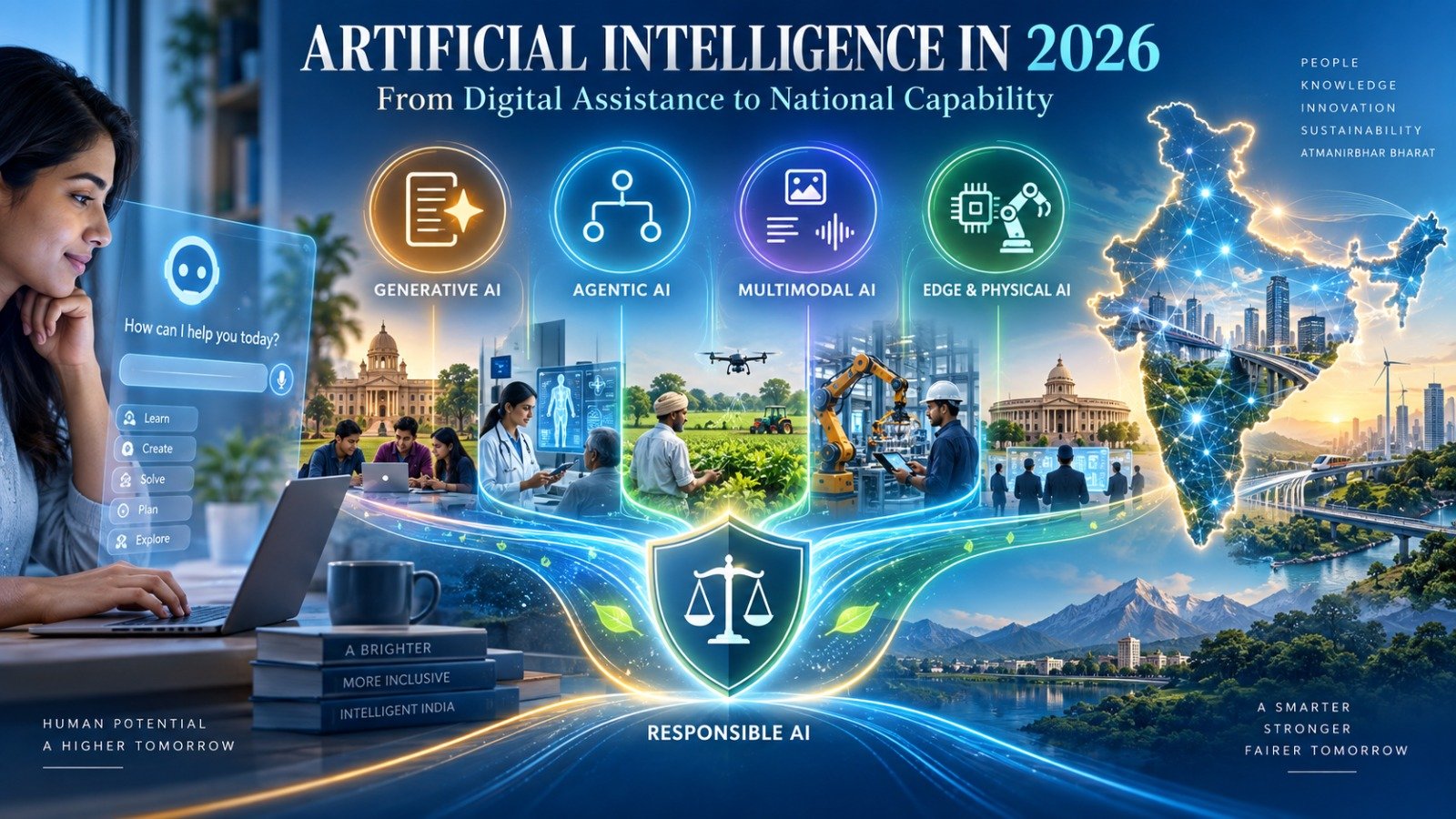
Five Directions Reshaping AI
GENERATIVE AI
Current AI technologies can write text, write code, assist in design, generate images, summarize reports, create learning, and help with academic research. Within education, it can assist teachers in developing teaching materials and tailoring explanations to the student’s needs. Its true power is in human-AI collaboration — freeing teachers, researchers, and students to save time, explore ideas, and uphold judgement, originality, and responsibility.
AGENTIC AI
Traditional chatbots answer queries, whereas AI agents can carry out other actions and processes, such as planning, using tools, tapping into databases, and executing multistep workflows — supporting admissions, help desks, placement preparation, and institutional analytics, as well as customer service, cybersecurity monitoring, and business intelligence in industry.
MULTIMODAL AI
Human knowledge is multimodal — acquired from words, images, speech, gestures, emotions, and social signals. AI systems now generalize across text, image, audio, video, and sensor data, enabling medical diagnosis, robotics, surveillance, agriculture, and smart classrooms, with particular value for India in language support and inclusive learning.
EDGE AI & ON-DEVICE INTELLIGENCE
AI models are being sent to local devices — smartphones, laptops, cameras, wearables, robots — instead of the cloud, enhancing speed, privacy, accuracy, and cost-effectiveness, and facilitating real-time decisions in health, manufacturing, agriculture, transportation, and defence.
AI technology is also making its way into the real world — off screen and into robotics, drones, autonomous machines, digital twins, and smart manufacturing systems. The importance of this to national capability is that strategic areas such as advanced manufacturing, disaster management, and space and defence technology need intelligent systems that can sense, reason, and act. Interdisciplinary laboratories that integrate AI and mechanical systems, electronics, simulations, sensors, and domain knowledge must be encouraged at universities.
India’s Public AI Infrastructure
India’s move towards AI is on a positive track. With compute infrastructure, data, start-ups, skilling, responsible AI, and indigenous innovation at the heart of it, the IndiaAI Mission has set a high bar. By 2026, official reports claim to have onboarded over 38,000 GPUs, which will be housed at a common compute facility for start-ups and academia. These are all necessary to complement talent if AI is to have a place at the leadership table.
Responsible AI Must Stay Front and Centre
Throughout education, recruitment, healthcare, finance, public services, and governance, the danger of bias, privacy, transparency, explainability, safety, and accountability issues must be tackled. The NIST AI Risk Management Framework and its Generative AI Profile, among other global frameworks, emphasize integrating trustworthiness into the design and use of AI systems. For universities, ethics, law, values, and social impact should be involved in addition to programming and algorithms in the education of AI.
AI is not just the technology of the future; it is a duty that education must tackle now.
Building AI as a University-Wide Capability
My focus is to make AI a capability for the university and not just a departmental phenomenon as a Dean-Centre of Artificial Intelligence. AI is essential for making business decisions in the management field. All Pharmacy students should learn AI in the fields of healthcare analytics and drug discovery. AI is required in engineering for automation and intelligent systems. AI is essential for financial intelligence in commercial applications. Humanities and social science students must be “AI Literate” to understand the digital society, digital policy, and communications policy. Teaching, research, industry linkage, student skilling, start-up incubation, patents, consultancy, and social and relevant innovation are important aspects of a strong AI centre.
Artificial Intelligence advances rapidly from digital help towards intelligent action. Generative AI is transforming creative domains, agentic AI is transforming workflows, multimodal AI is transforming perception, edge AI is transforming devices, physical AI is changing machines, and responsible AI is changing governance. Institutions that train students in the ethical, creative, and practical applications of AI will be the true drivers of national progress.
Keywords: Generative AI · Agentic AI · Multimodal AI · Edge AI · Responsible AI · IndiaAI Mission · National Capability
References
- IndiaAI. (2026). IndiaAI Mission pillars and compute capacity. Ministry of Electronics and Information Technology, Government of India. https://indiaai.gov.in/
- Press Information Bureau. (2026, March 25). IndiaAI Mission expands AI ecosystem with affordable access to compute capacity. Government of India. https://www.pib.gov.in/
- Maslej, N., Fattorini, L., Perrault, R., Gil, Y., Parli, V., Kariuki, N., Capstick, E., Reuel, A., Brynjolfsson, E., Etchemendy, J., Ligett, K., Lyons, T., Manyika, J., Niebles, J. C., Shoham, Y., Wald, R., Walsh, T., Hamrah, A., Santarlasci, L., … Oak, S. (2025). Artificial Intelligence Index Report 2025. Stanford Institute for Human-Centered AI. https://hai.stanford.edu/ai-index/2025-ai-index-report
- National Institute of Standards and Technology. (2024). Artificial Intelligence Risk Management Framework: Generative Artificial Intelligence Profile (NIST AI 600-1). U.S. Department of Commerce. https://www.nist.gov/
- UNESCO. (2024). AI competency frameworks for teachers and students. United Nations Educational, Scientific and Cultural Organization. https://www.unesco.org/
About the Author
Dr. Sumegh Tharewal
Dean – Centre of Artificial Intelligence, Indira University, Pune
Dr. Sumegh Tharewal is the Dean – Centre of Artificial Intelligence, Indira University, Pune. He has academic and research experience in Artificial Intelligence, Machine Learning, IoT, Blockchain, Multimodal Biometrics and emerging technologies. His work focuses on building future-ready academic ecosystems through AI-driven education, interdisciplinary research, industry collaboration, innovation and skill-based learning. As Dean of the Centre of Artificial Intelligence, he is committed to developing AI capabilities that support education, employability, research excellence, entrepreneurship and national development.