
Table of Contents
How 67,000 km of railway and 1,46,195 km of national-highway corridor land can be transformed into the world’s largest productive agroforestry network — creating 15–20 lakh rural jobs, capturing carbon, and generating a ₹1 trillion annual rural economy at zero additional government expenditure.


There is a question no Indian policy document has asked with sufficient directness: what should the trees alongside India’s 67,000 route kilometres of railway network and 1,46,195 kilometres of national highways actually produce?¹⁶
For decades, the answer has been nothing in particular. Indian Railways owns 4.90 lakh hectares of land¹ — confirmed as the single largest institutional landowner in India.² The CAG Report tabled before the Lok Sabha (December 2023)³ found that Railways had awarded only 87.76 hectares — 0.14% of vacant land — to commercial developers, with zero sites developed as of March 2023. The CAG identified non-fare revenue as a critical component of Railways’ financial strategy³ and documented its near-total failure to materialise.
NHAI has planted 469.75 lakh saplings along national highways since the Green Highways Policy 2015,⁷ at an 82% verified survival rate.⁵ The National Agroforestry Policy 2014⁸ — India’s, and the world’s, first — explicitly supports productive tree plantation on government non-forest land. Neither policy currently mandates commercially productive, fruit-bearing species.
“India already owns the world’s largest publicly held productive green land bank. The question is no longer whether to plant — it is what to plant, and who benefits.”
THE PROPOSAL
The Productive Green Corridor Mission (PGCM) proposes one enforceable change: 70% of all new and replacement plantations along Railway and Highway corridors must be commercially productive, fruit-bearing agroforestry species — selected against National Horticulture Board agroclimatic zone data,¹² operated by Farmer Producer Organisations and Women’s Self-Help Groups under a revenue-sharing model, and financed entirely through the existing Green Highways Fund⁷ and Railway CPSE CSR spend under Schedule VII of the Companies Act, 2013.⁹ Net new Government capital expenditure required: ₹0.
THE ECONOMIC CASE — CITED & AUDITABLE
Built on APEDA export data,¹⁵ NHB yield series,¹² and FSSAI/MoFPI value-addition multipliers:¹⁴
| Value Chain Step | Annual Value (Mature Phase) | Source |
|---|---|---|
| Farmgate produce (14–18 crore trees) | ₹12,000–18,000 Cr | NHB yield & price data |
| Processing & value addition (2×) | ₹24,000–36,000 Cr | FSSAI / MoFPI multiplier |
| Export premium (APEDA crops) | ₹8,000–12,000 Cr | Moringa, amla, guava |
| Carbon credits (CIFOR-ICRAF) | ₹3,000–5,000 Cr | 15–25 tCO₂e / ha / yr |
| Eco & agri-tourism | ₹2,000–4,000 Cr | Ministry of Tourism projections |
| Total rural economy | ₹50,000–75,000 Cr | → ₹1 trillion pathway |
India is the world’s second-largest horticulture producer (362.08 MT, FY25¹⁵) yet holds only about 1% of global market share.¹⁵ FPO supply chains address this gap directly.
EMPLOYMENT — 20+ ACTIVITY CATEGORIES
Estimated using MGNREGS labour norms¹⁸ and NHB advisory data:¹² nurseries and plantation (1.5–2.5 lakh), harvesting and sorting (4–6 lakh), cold chain and processing (1.5–2 lakh), women’s SHG enterprises (2–3 lakh), and drone/GIS/digital and carbon-audit roles (30,000–43,000). Total direct employment: 15–20 lakh, with a further 30–40 lakh indirect and induced. India’s 10,000-FPO Scheme (₹6,865 Cr)¹⁹ and NABARD’s Credit Guarantee Scheme²⁰ provide the institutional backbone for Year-3 financial self-sufficiency.
NDC ALIGNMENT — CITED FROM UNFCCC
India’s Updated NDC (UNFCCC, August 2022)²¹ commits to a 2.5–3 billion tCO₂e additional carbon sink by 2030, raised to 3.5–4 billion tCO₂e by 2035 (Cabinet, March 2026).²² Fruit trees sequester 15–25 tCO₂e/ha/yr¹⁶ — substantially more than ornamental alternatives — advancing NDC targets at zero additional public cost.
FIVE APPROVALS SOUGHT FROM GOVERNMENT OF INDIA
| # | Approval Sought | Basis |
|---|---|---|
| 1 | NITI Aayog recognition of PGCM | GoI Resolution, 2015 |
| 2 | Railway Board circular: 70% productive species | Railways Act, s.4 |
| 3 | Green Highways Policy 2015 amendment | MoRTH circular |
| 4 | MCA clarification: CSR Schedule VII eligibility | Companies Act, 2013 |
| 5 | In-principle five-district pilot approval | RLDA / NHAI framework |
AGROCLIMATIC SPECIES MAPPING (NHB ZONE DATA)
| Corridor Zone | PGCM Species | Market Alignment |
|---|---|---|
| Himalayan foothills | Litchi, walnut, amla | GI-tagged premium; export focus |
| Northern plains | Guava, amla, mango | India global leader; high domestic demand |
| Western arid | Moringa, ber, pomegranate | Moringa: USD 6.4 Bn global market |
| Deccan plateau | Tamarind, custard apple | High agro-processing demand |
| North-East corridor | Jackfruit, Assam lemon | NE Horticulture Mission alignment |
| Coastal belt | Cashew, coconut, jackfruit | High export & domestic value |
ROADMAP — 2026 TO VIKSIT BHARAT 2047
| Phase | Key Milestone | Target |
|---|---|---|
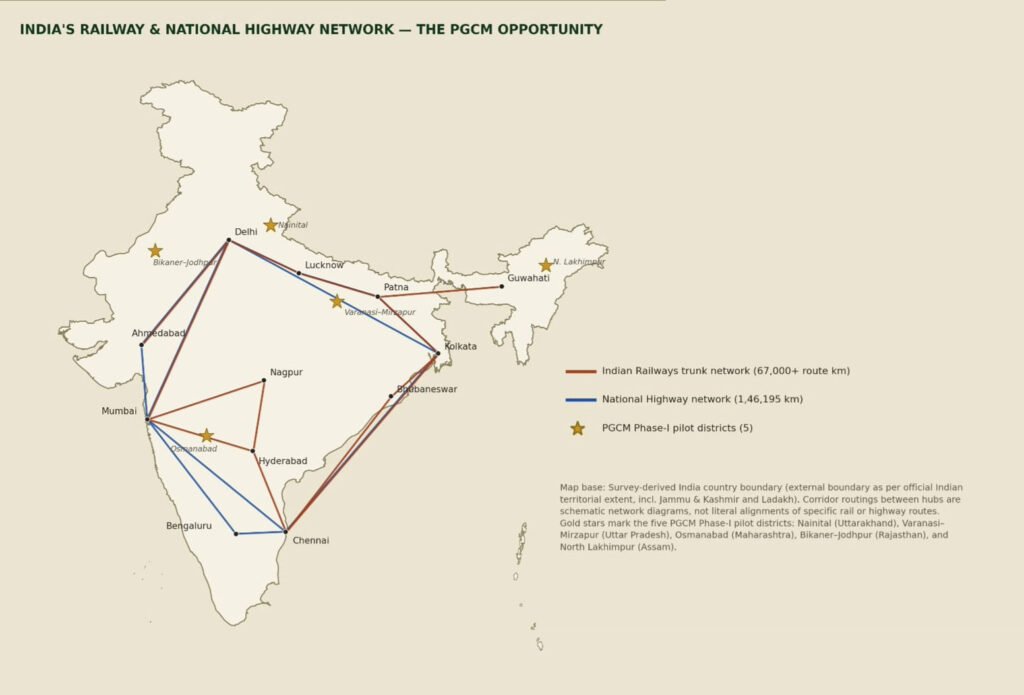
| 2026–27 | Policy: Railway circular + Green Highways Policy amended; 5 FPOs licensed | 5 districts |
| 2027–28 | Plant: 10 lakh trees geo-tagged; NABARD credit activated | 50+ segments |
| 2030 | First harvest: revenue-sharing begins; carbon certified; COP showcase | ₹2,000+ Cr |
| 2035 | National: all 28 states; 5 crore trees; 15–20 lakh direct jobs | ₹20,000 Cr/yr |
| 2047 | Viksit Bharat: ₹1 trillion rural economy; NDC target met | Viksit Bharat |
“Let us grow prosperity. Not just plantations.”
Every policy instrument above already exists. Every ministry already has jurisdiction. Every fund is already operational. PGCM requires only the willingness to look at existing assets differently. India has already built the corridors; the land belongs to the nation; the science exists; the institutions are in place; the communities are ready. What remains is one national decision — to transform connectivity into productivity, and infrastructure into prosperity.
About the Author
Dr. Inder Negi
National Secretary, IITDO · Founding Member, Himalayan Foundation (Since 1991), Uttarakhand
Dr. Inder Negi holds a PG Diploma in Cyber Law, LL.M. in Corporate Law, and an MBA. He is a Researcher at FAIR Research Organization – Asia, a Member of GALTER and the Malaviya Mission, and Honorary Director of India Relations at Etherea Global University, USA. He serves as National Secretary of IITDO and Core Member of the Europe Asia Economic Summit, working at the intersection of governance, causal analytics, and public policy across healthcare, trade, and institutional reform. He is a founding member of the Himalayan Foundation, Uttarakhand, established in 1991.