

Table of Contents

Google stopped asking for degrees. So did Apple, IBM, and half the Fortune 500. In India, a Bengaluru startup hired its last three engineers off GitHub alone. The rules of recruitment are changing, and they are not waiting for the education system to catch up. Whether India’s colleges and its CSR investments get there in time is the question worth asking.
KEY FIGURES AT A GLANCE
- 50.3%Graduate employability rate (ISR 2023)
- 43.3MStudents in higher education (AISHE 2021-22)
- 50%PMKVY placement rate (CAG 2025)
- ₹1,430 CrCSR spend on vocational skills FY 2023-24
In 2021, Google announced it would no longer require a college degree for most of its roles. Apple, IBM, and Accenture followed. In India, Zoho has long hired through its own school, bypassing degree requirements entirely and has built one of the country’s most admired engineering teams in the process. Across the startup ecosystem, hiring managers increasingly scroll through GitHub repositories and design portfolios before they look at a resume. The credential, for a growing class of employers, has become secondary to the demonstrated capability.
This seems to be the early signals of a structural shift in how the world of work defines readiness. As per a co-published report of CII and AICTE (Wheebox India Skills Report 2023), across 3.75 lakh candidates, found that only 50.3% of assessed youth were genuinely employable. That number has improved modestly. It still means roughly one in two graduates stepping into the job market is not prepared for the work available, not by the standards of traditional employers, and certainly not by the standards of the new ones.
The economy is moving toward skills, employers are beginning to act on it, and the education system, along with the CSR investments meant to support it, has largely not caught up. This is becoming the central tension of India’s employability moment.
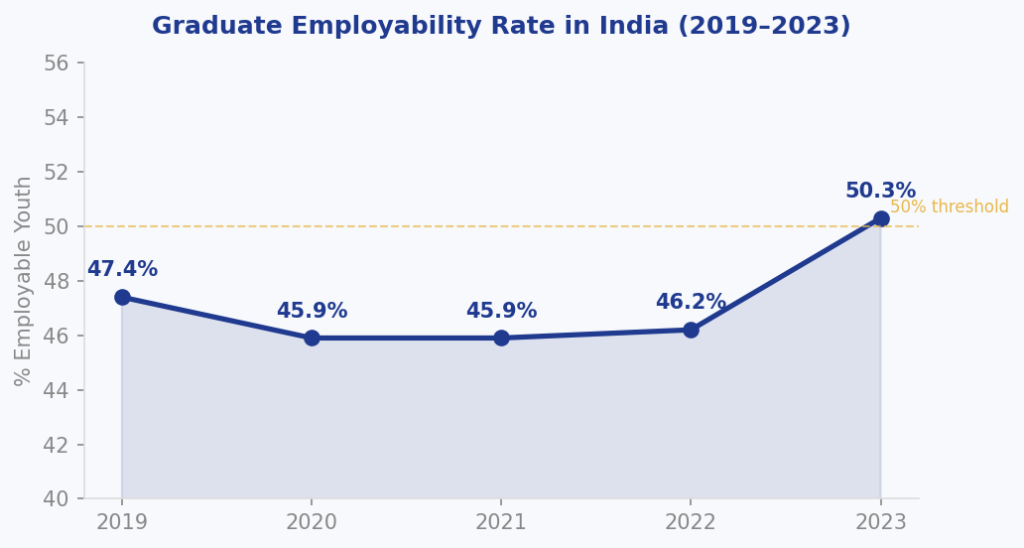
Source: Wheebox India Skills Report 2023, CII & AICTE
The New Rules of Hiring
The shift from degree-based hiring to skill-based hiring did not happen overnight. But the direction of travel is now clear enough to constitute a trend. In the United States, over half of job postings from major employers no longer list a four-year degree as a requirement. In India, the movement is an early stage but seems to be accelerating one. This shift can be attributed to the startup ecosystem, the tech sector, and a growing cohort of employers who have learned through experience that the degree is a poor proxy for the capabilities they actually need.
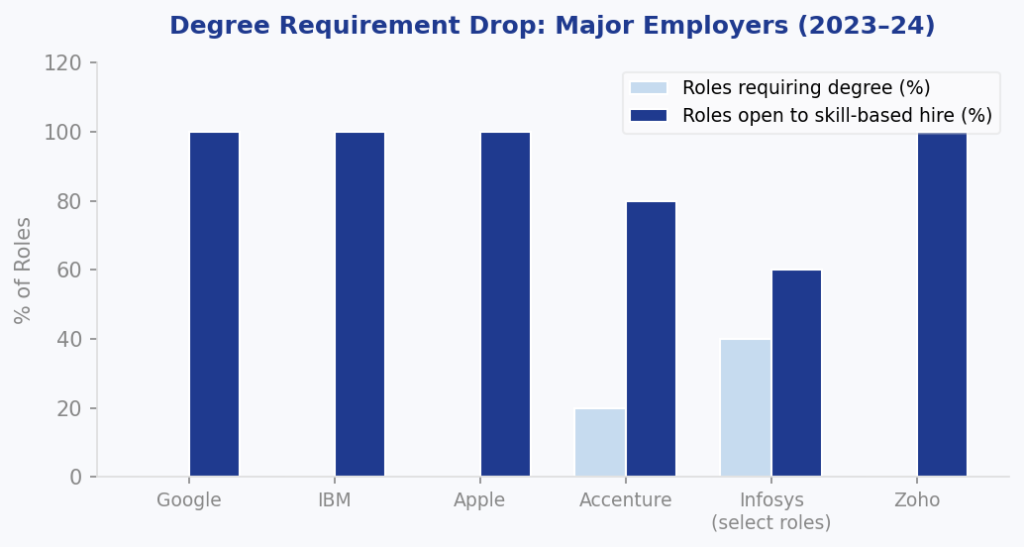
Source: Company hiring announcements; LinkedIn Workforce Report 2024
What Startups Are Actually Hiring For
India’s startup ecosystem, 100,000+ registered startups, the third-largest in the world, has been among the most aggressive in redefining what a hireable candidate looks like. For a seed-stage company building a product, a candidate who has shipped code on open-source projects, designed a functional app, or demonstrated measurable outcomes in a previous role is worth more than any transcript. The time and resources to train a credential-holder are simply not available.
The AI Layer
The arrival of generative AI has accelerated this shift considerably and added a new dimension to what employability means.
For Indian graduates, this creates both a threat and an opening. The threat is that routine cognitive tasks, data entry, basic coding, among others which were considered to be a reliable entry-level employment, are now being automated faster than the education system can redirect students. The opening is that the skills AI cannot easily replicate, contextual judgment, communication, and the ability to ask the right question before answering it, are precisely the skills that good education develops. The problem is that most Indian undergraduate programmes develop neither the technical fluency to work with AI tools nor the higher-order skills that make humans valuable alongside them.
The gap in employability is not about whether graduates can fill today’s vacancies. It is more likely the ability of students to navigate a labour market that will look substantially different in five years. The implication is significant.
Why the System Has Not Kept Up
If the direction of the labour market is clear, and employers are beginning to act on it, the obvious question is why the education system has not adjusted. The answer is structural, and it runs deep.
Curricula Designed for a Different Economy
NAAC assessments have repeatedly found that many affiliated colleges have not substantially revised their programmes in years. It was found that employability gaps persist across almost all degree streams, with engineering and polytechnic graduates (Wheebox India Skills Report 2023).
The affiliating university system makes rapid change cumbersome, a college that wants to introduce AI tools, design thinking, or project-based assessment must navigate bureaucratic processes that were not designed for the pace at which skills now evolve.
The Pedagogy Problem
The current system only tests recall of students, evaluates faculty on pass percentages. Rather it should focus on student outcomes, there should be incentives to push for deeper or more applied learning. With the current education system, the result is mostly graduates who can reproduce answers but most likely will struggle to frame questions, precisely the inverse of what AI-era employers need.
Concerns such as poor written communication, inability to work with minimal supervision, and limited exposure to real tools and workflows, have been highlighted by employers from fintech startups to manufacturing firms. There are issues related to a preparation gap that the system has not been designed to close.
The Geography of Missed Opportunity
AISHE 2021-22 data records steady growth in SC, ST, and OBC enrolments. This progress on access does not prepare students for the economy they are entering. IIT and NIT graduates navigate the new hiring landscape relatively well. The students who face the sharpest mismatch are the overwhelming majority. Students studying at Tier 2 and Tier 3 institutions where industry exposure is rare, AI tools may not appear in a single lecture, and the idea of building a professional portfolio is simply unknown.
What Policy Has Tried and Where It Falls Short
NEP 2020: The Right Framework, Stalled Implementation
At the level of intent, the National Education Policy 2020, explicitly acknowledges the employability challenge. It discusses mandatory internships, flexible credit systems, multidisciplinary learning, and greater institutional autonomy, all of which are needed to bridge the gap between educational and industry requirements.
The vocational integration provisions that matter most for closing the skills gap have received the least attention in implementation. For most students in most colleges, NEP 2020 has so far been a policy document rather than a lived experience.
PMKVY: Scale Without Sufficient Depth
Since 2015, the government has trained over 1.64 crore youth under PMKVY. The CAG Report found that of 56 lakh candidates certified under short-term training, only 41% secured placements. Training content was frequently misaligned with actual job vacancies. Most critically, under PMKVY 4.0, the government has stopped tracking placements altogether, delinking the programme from the only outcome that actually measures its success.
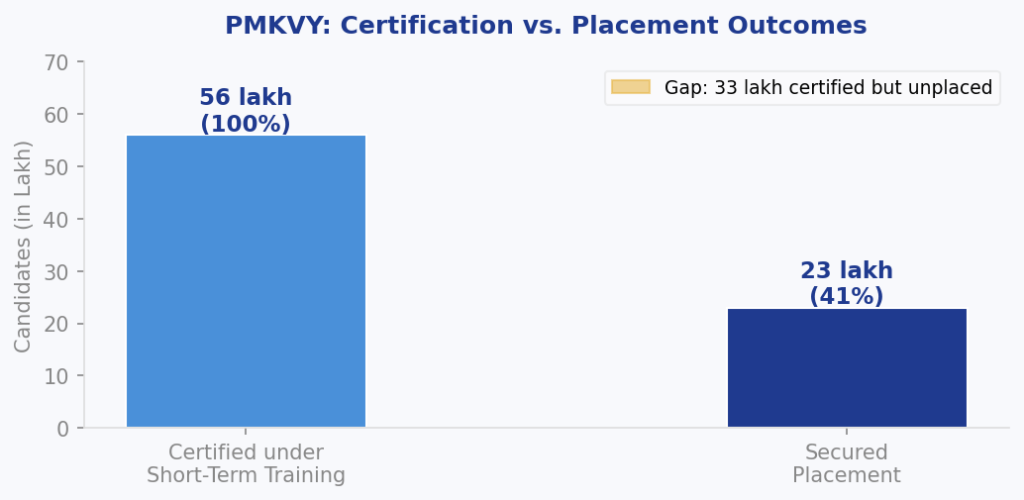
Source: CAG Report No. 20 of 2025
India has built training infrastructure on an impressive scale. What it hasn’t built is training that matches the economy it is training people for, one where adaptability and AI fluency matter as much as any fixed technical skill.
The CSR Opportunity: From Compliance to Transformation
What the Funding Landscape Looks Like
Under Section 135 of the Companies Act, 2013, qualifying companies must spend 2% of average net profits on CSR. According to the MCA data, total CSR expenditure in FY 2023-24 reached ₹34,909 crore. Education received ₹12,508 crore, approximately, one-third of the total spend. Vocational skills, a more targeted category, received ₹1,430 crore.
Seeing the trend, much of the CSR flows into education, still is likely to fund infrastructure, scholarship, and short-duration training camps related interventions that improve access without necessarily improving outcomes. The new employability challenge requires a different kind of investment.
What Actually Works?
Outcome-tracked direct skilling: For instance, Tata STRIVE, operated by Tata Trusts across 24 states and 2.5 million+ beneficiaries, is built around soft skills. It focuses on workplace orientation, and the ability to communicate professionally as determinative of employment outcomes as technical certification. Its Youth Development Module, a life skills and mindset programme that precedes all technical training, addresses the preparation gap that degrees leave entirely. With 80-85% of candidates placed within three months, the results are a function of design, not scale.
AI and digital skills integration: A growing number of CSR-funded programmes are beginning to incorporate AI literacy, data handling, and digital workflow training as core components. NASSCOM’s Future Skills initiative, which works at the institution level to embed technology competencies into college curricula, represents the kind of systemic intervention that addresses the AI-era mismatch directly. The logic is straightforward: you cannot build AI-ready graduates by teaching pre-AI curricula.
Employer-led hiring pipelines: Programmes that ask companies to co-design assessments, provide live project briefs, and commit to hiring from a cohort, produce graduates who have already demonstrated capability in real work contexts. For any CSR model, the focus should be on closing the loop between training and employment by making the employer an active participant in programme design. This is, in effect, an approximation of the apprenticeship model that has produced strong employment outcomes in Germany and the UK, adapted for the Indian context.
The Gaps CSR Has Not Yet Filled
- Trainings on digital, market ready skills and AI literacy among college students (Tier 2/3) remains almost absent from CSR portfolios
- CSR spending geographically remains concentrated, while the deepest skills gaps are in precisely the states that receive the least
- Funders focus on output (no. of trainees placed) over outcomes, very few programmes measure whether graduates are still employed, and in what, after 12 months
- The connection between CSR-funded training and actual employer hiring pipelines remains weak in most programmes
The Way Forward
The employability revolution that employers are driving is not waiting for the education system to catch up. The question is whether policy, institutional practice, and CSR investment can accelerate the transition or whether the gap widens further while the debate continues.
FOR POLICYMAKERS
- Invest in helping universities/colleges to implement NEP 2020 by strengthening industry connections, expanding internship opportunities to ensure students gain job-ready skills
- Reform PMKVY’s central focus to train youth for emerging job roles
- Make 12-month employment outcomes a public performance metric for PMKVY components
- Mandate AI and digital fluency modules as core components of all programmes that are either government-funded skilling programmes or CSR-backed
- Create regulatory incentives for companies that partner with colleges on curriculum co-design and employer-led assessment
FOR THE CORPORATE SECTOR
- Design CSR skilling programmes around what you are actually hiring for, not generic soft skills or legacy certifications
- Introduce AI literacy and digital fluency as a core component of any employability intervention
- Pool resources with peer companies in sector consortia to fund interventions at the institutional level so that every student gets the benefit from changed college’s curriculum, not just one cohort
- Shift focus from outputs to outcomes — publish 12-month employment outcome data from CSR-funded programmes
- Employer-led hiring pipelines should be promoted as part of programme architecture
FOR EDUCATIONAL INSTITUTIONS
- AI tools, data literacy, and digital workflows should be treated as priority
- Make internships, live projects, and industry interactions an integral part of the learning experience
- Move towards experiential, and problem-solving learnings that allow students to apply knowledge in real-world contexts
Conclusion: The Revolution Is Already Underway
The job market is evolving – employers who once required degrees are looking for job ready skills.
India is well-positioned to benefit from this shift. But only if its educational institutions, government programmes, and CSR investments begin to train for the economy that exists. NEP 2020’s framework, if implemented seriously and fully in state universities, could begin to close the preparation gap at scale. The amount of ₹1,430 crore spent on vocational skills through CSR in FY 2023-24 alone could be genuinely transformative if directed toward AI-ready, and employer-connected interventions.
The question is no longer only how to fix the system that exists. It is how to build the pipeline that the new economy needs, quickly enough to matter for the cohort entering college today.
The revolution in hiring is underway. The question is whether India’s education and skilling ecosystem joins it or gets left behind.
About the Author
Asmita Yadav
Deputy General Manager, MLE · DevInsights
Asmita Yadav is a social researcher with over 5 years of experience in monitoring, learning, and evaluation across the social sector. She currently serves as Deputy General Manager, MLE at DevInsights. She holds an MBA in Development Management from the Indian Institute of Forest Management, Bhopal. Her areas of expertise include social research, assessment and evaluations in the education, climate, WASH and livelihood domain. She has published a paper in Dev Insights Working Paper Series, Volume 1 (ISBN: 978-81-990723-7-4) and has contributed articles to FirstPost and Clear Cut Magazine.