
Table of Contents

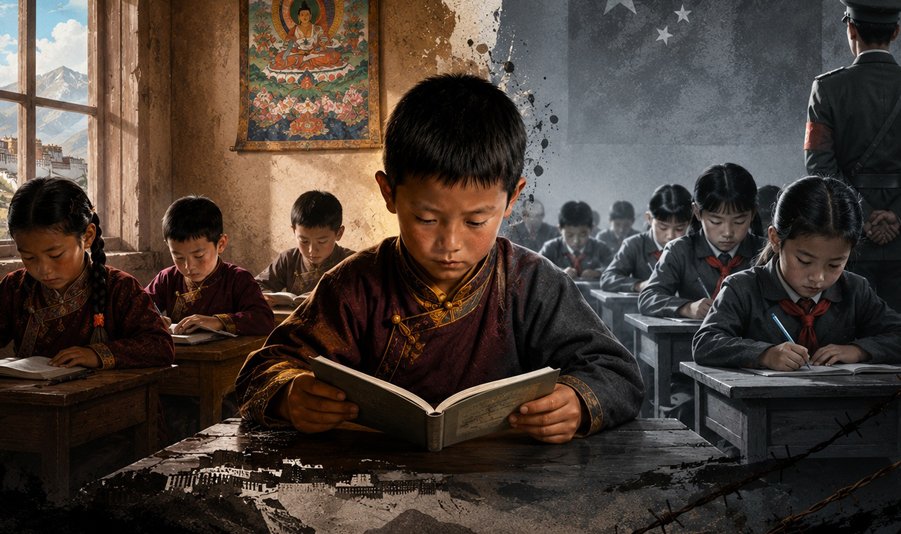
Across the Tibetan plateau, the sharpest edge of a seven-decade struggle over identity is no longer found only in monasteries or protest squares — it runs through the classroom. What is taught to a child, and in which language, is now central to whether a thousand-year-old culture survives into the next generation.
A System Built to Replace, Not Educate
Since the 1950s, Tibet’s traditional centres of learning — its monasteries — have borne the brunt of political control. The Cultural Revolution alone destroyed more than 6,000 monastic institutions, wiping out centuries of accumulated scholarship. What has followed in recent decades is quieter but, educators and rights groups argue, no less consequential: a vast network of state-run residential schools that separate Tibetan children from their families for months at a time.
A 2023 Human Rights Watch investigation found hundreds of thousands of Tibetan children enrolled in these boarding schools, where Mandarin has steadily displaced Tibetan as the language of instruction. UN Special Rapporteurs who reviewed the policy in 2022 described it in stark terms.
“A systematic effort to sever Tibetan children from their language, culture, and community.” — UN Special Rapporteurs, 2022
The UN Committee on the Rights of the Child raised similar concerns the same year, and the pattern echoes a broader trend documented by the Congressional-Executive Commission on China: a widening gap between what a Tibetan child learns at home and what a Tibetan child is taught at school.
Language Loss, Generation by Generation
Linguists studying endangered languages point to a familiar warning sign: when a mother tongue disappears from the classroom, it rarely survives for long in daily life. As Mandarin becomes the default medium of instruction, and as infrastructure projects such as the Qinghai-Tibet Railway draw more Han settlers into cities like Lhasa, young Tibetans increasingly grow up schooled, and surrounded, in a language and curriculum shaped far from home.
The consequence, educators argue, is not simply fewer Tibetan speakers — it is a generation with thinner ties to the oral histories, religious texts, and cultural practices that have carried Tibetan identity for a millennium.
Education as Resistance: The Exile Model
Outside Tibet, a very different educational project has taken root. The Central Tibetan Administration, headquartered in Dharamshala, India, runs schools built specifically to keep Tibetan language, history, and Buddhist philosophy alive among the roughly 94,000 Tibetans who have found refuge in India since 1959. The Library of Tibetan Works and Archives, also in Dharamshala, holds one of the world’s most significant collections of Tibetan manuscripts — a living counter-archive to what has been lost at home.
These exile institutions matter beyond nostalgia. They function as a working proof that Tibetan education can exist on its own terms — a model advocates hope could one day inform how Tibetan children are taught inside Tibet itself.
Why This Is Everyone’s Concern
Organisations such as Bharat-Tibbat Sahyog Manch, founded in 1999 and now active through more than 250 chapters across India, frame the education question as part of a larger civilizational stake shared between India and Tibet — one rooted in the historic transmission of Buddhist thought and in India’s own decision to shelter the Dalai Lama and generations of Tibetan refugees.
Legislative gestures like the United States’ Tibetan Policy and Support Act of 2020 signal international concern, but implementation remains limited. Meanwhile, Freedom House’s 2024 assessment rates Tibet’s political and civil freedoms at just 1 out of 100 — among the lowest scores recorded anywhere, an environment in which control over education becomes control over a people’s future.
The debate over Tibetan boarding schools is, at its core, a debate about who gets to decide what a child learns, in what language, and from whom. For Tibet, the answer to that question may determine whether its culture is carried forward by the next generation — or quietly replaced by it.
At a Glance: The Education Crisis
| Children affected | Hundreds of thousands enrolled in state boarding schools, per Human Rights Watch (2023) |
| Medium of instruction | Mandarin increasingly replacing Tibetan in classrooms |
| UN response | UN Special Rapporteurs (2022) describe a systematic effort to sever children from their heritage |
| Exile safeguard | Central Tibetan Administration (Dharamshala) runs schools and archives preserving Tibetan language and texts |
| Key legislation | U.S. Tibetan Policy and Support Act, 2020 |
Timeline: Education Under Pressure
| 1959 | Dalai Lama flees to India; Tibetan exile school system begins taking shape |
| 1966–76 | Cultural Revolution destroys over 6,000 monasteries, historic centres of Tibetan learning |
| 2006 | Qinghai-Tibet Railway accelerates Han migration, reshaping Lhasa’s schools and streets |
| 2022 | UN Committee on the Rights of the Child raises alarm over boarding-school policy |
| 2023 | Human Rights Watch publishes “China’s Massive System of Boarding Schools in Tibet” |
References
- Human Rights Watch (2023)
- UN Committee on the Rights of the Child (2022)
- UN Special Rapporteurs (2022)
- Freedom House, Freedom in the World 2024
- Congressional-Executive Commission on China, Annual Report 2023
- 116th U.S. Congress, Tibetan Policy and Support Act of 2020.
About the Author
Mr. Pankaj Goyal
Mr. Pankaj Goyal serves as the National General Secretary of Bharat-Tibbat Sahyog Manch (BTSM), a pan-India socio-cultural organization committed to supporting the Tibetan cause and advocating for a free Tibet. A former Pracharak of the Sangh, he has dedicated a significant part of his life to national and social service, with Delhi being a key area of his work and influence.
With over two decades of active involvement under the guidance of Shri Indresh Kumar, Patron (National) of BTSM, Mr. Goyal has played a pivotal role in strengthening the organization’s outreach and impact across the country.
Founded on May 5, 1999, Bharat-Tibbat Sahyog Manch works towards the freedom of Tibet and the liberation of Kailash Mansarovar, and today operates through 250+ chapters across India. Through his leadership, Mr. Goyal continues to contribute to this mission by fostering awareness, national dialogue, and coordinated action in support of Tibet and its cultural heritage.