
Table of Contents

Deterrence, Diplomacy, and Stability
A Defining Moment
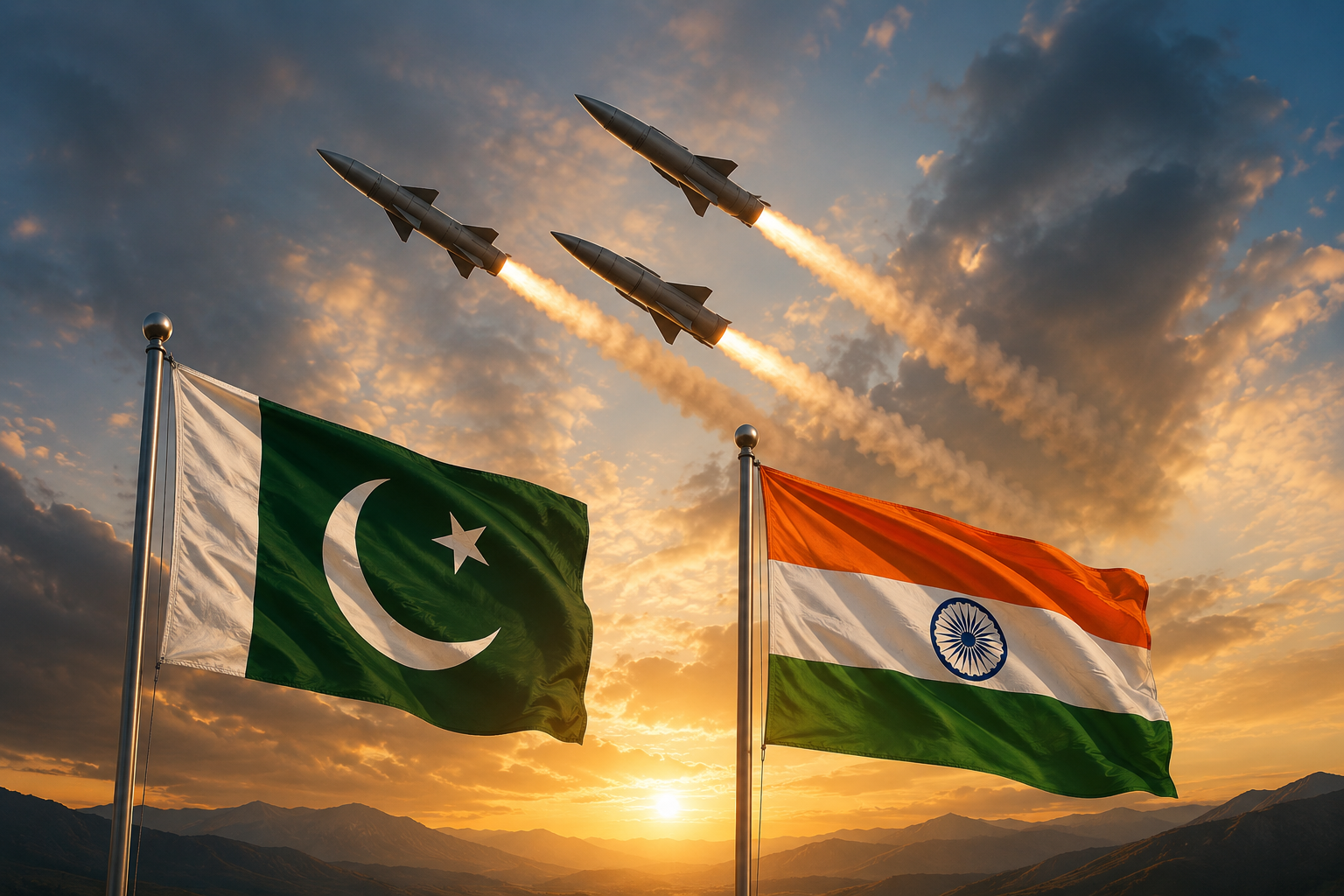
On the night of 6–7 May 2025, India carried out a swift, coordinated military operation — lasting under twenty-five minutes — against nine terrorist infrastructure sites in Pakistan and Pakistan-administered Kashmir. The targets belonged to Jaish-e-Mohammed and Lashkar-e-Taiba, the two groups most closely tied to cross-border terrorism against India. Named Operation Sindoor, the strike was India’s answer to the Pahalgam massacre of 22 April 2025, in which 26 civilians, mostly tourists, were killed.
Prime Minister Narendra Modi called it the start of a “new normal” in how India responds to state-sponsored terrorism. For historians, it marks not an end to India–Pakistan hostility, but a real shift in its terms.
Seven Decades of Structured Hostility
The relationship has been adversarial since Partition in 1947, which uprooted roughly fourteen million people. Four wars — 1947, 1965, 1971, and Kargil in 1999 — left behind unresolved disputes and entrenched military postures on both sides.
From the 1980s, Pakistan increasingly used cross-border terrorism as a strategic tool, producing attacks such as the 2001 Parliament assault, the 2008 Mumbai attacks, the 2016 Uri attack, and the 2019 Pulwama bombing that killed 40 CRPF personnel. India’s responses — the 2016 surgical strikes and the 2019 Balakot air strikes — showed growing willingness to act, but only partially deterred future attacks, and Pakistan’s official posture of condemning terrorism while parts of its state apparatus enabled it remained largely unchanged.
Periodic diplomatic efforts — the Simla Agreement (1972), the Lahore Declaration (1999), the Agra Summit (2001), and various confidence-building measures — repeatedly raised hope but never resolved the core problem: normalization would require Pakistan’s military establishment to give up a tool it sees as strategically essential.
A New Kind of Deterrence
Operation Sindoor was India’s largest military action against Pakistan since 1971. According to India’s Director General of Military Operations, more than 100 militants were killed, including figures linked to the 1999 IC-814 hijacking and Pulwama. India’s forces reportedly jammed Pakistan’s Chinese-supplied air defenses, while the indigenous Akash missile system intercepted retaliatory drones and projectiles, in a coordinated effort across the Air Force, Army, and Navy.
India’s Chief of Defence Staff, General Anil Chauhan, later described the doctrine behind the operation: combining a no-first-use nuclear policy, precision targeting limited to terrorist infrastructure, and no territorial ambitions creates real space for conventional military responses that stay below the nuclear threshold. This directly challenges Pakistan’s long-standing assumption that nuclear ambiguity shields it from consequences for sponsoring terrorism.
Analysts have since described this as India’s new red line: state-backed terrorism will draw punitive military force, regardless of nuclear signaling. The Carnegie Endowment noted the operation reflected a real maturing of India’s precision-strike capability and its political will to use it — reducing the old binary choice between inaction and full-scale war.
Diplomacy: Mixed Results
The military success was not matched diplomatically. The 88-hour conflict ended in a ceasefire on 10 May 2025, but its authorship was disputed — U.S. President Donald Trump publicly claimed credit for brokering it, a claim India rejected, insisting the ceasefire was reached bilaterally on its own terms. Pakistan, by contrast, embraced the U.S. framing and even nominated Trump for the Nobel Peace Prize.
International condemnation of Pakistan following Pahalgam was notably weaker than after the 2008 Mumbai attacks, suggesting India’s diplomatic leverage hasn’t kept pace with its military capability. Complicating matters further, China reportedly supplied Pakistan with equipment, satellite imagery, and targeting support during the crisis — a reminder that bilateral frameworks alone can’t address the broader regional picture.
The Nuclear Dimension
Both countries hold comparable nuclear arsenals (Pakistan estimated at around 170 warheads, India in a similar range per SIPRI), meaning any conventional clash carries real escalation risk. India’s case for staying below the nuclear threshold rested on three points: its no-first-use policy, Pakistan striking military targets first, and India’s own restriction to terrorist infrastructure. That logic held during Sindoor, but coherent logic isn’t the same as guaranteed safety going forward.
The cost of continued hostility is also economic: the Asian Development Bank estimates that removing India–Pakistan trade barriers could push bilateral trade from near-zero to over USD 37 billion annually — a substantial toll on Pakistan’s already strained economy in particular.
What Comes Next
Tiwari argues India now needs to pursue three things together:
- Deterrence — building on Sindoor’s demonstrated precision-strike and electronic-warfare capabilities.
- Diplomacy — using partnerships with the U.S., EU, and the Quad more deliberately to sustain international pressure on Pakistan’s terror networks, addressing the gap between the muted response to Pahalgam and the stronger post-Mumbai reaction.
- Crisis management — strengthening direct channels like the DGMO hotline, which helped prevent miscommunication during Sindoor, and exploring confidence-building measures around nuclear doctrine communication.
He also notes that India’s current stance — that talks require Pakistan to act against terror groups on its soil — is defensible, but a framework offering no path to eventual normalization risks becoming self-defeating. Track-II dialogue and academic exchange can keep communication alive even when official diplomacy is frozen.
Conclusion
Operation Sindoor showed India has both the capability and the will to answer state-sponsored terrorism with calibrated force, while managing the nuclear dimension carefully. But military success alone doesn’t resolve the underlying political contest — it has, at best, created a window. Converting that window into lasting stability will depend on sustained Indian statecraft, and on whether political forces within Pakistan ultimately choose accommodation over confrontation.
Key Insights
- Leadership is the critical bridge between NEP 2020 policy intent and institutional practice.
- Industry–academia collaboration has shifted from optional to imperative for relevance and impact.
- Applied and experiential research is replacing siloed, publication-only academic research.
- Cultural change within institutions is as important as structural reforms.
About the Author
Dr. Sachin Tiwari
Professor & Dean, Faculty of Social Sciences | Director (Research & Development), Gyanveer University, Sagar
is a senior academician and research leader in History with over 17 years of experience in teaching, research, and university administration. He has held several key academic and administrative roles, including Head of Department, Ph.D. Coordinator, and NAAC Research In-charge. His expertise spans Jammu & Kashmir studies, India–Tibet relations, Modern Indian History, and West Asian studies. He has guided multiple Ph.D. scholars, authored books, and contributed extensively to national and international research publications.