
Table of Contents

The New Architecture of Industry-Integrated Education
In the corridors of higher education institutions across India, a quiet revolution is underway. Lecture halls once echoing solely with theoretical concepts now resonate with discussions about real-world applications, entrepreneurship, and problem-solving.
The driving force behind this shift is the increasing collaboration between industry and academia — a partnership that is no longer optional but imperative if India is to cultivate a generation of innovators, leaders, and thinkers who can thrive in a globally competitive landscape.
This convergence is not just a matter of aligning curricula with market needs; it is a profound reimagining of higher education itself, one that the National Education Policy (NEP) 2020 has championed. The NEP emphasizes flexibility, interdisciplinary learning, experiential engagement, and robust industry linkages. But translating these policy aspirations into tangible outcomes demands more than guidelines; it requires visionary leadership, adaptive institutional frameworks, and a shared commitment between policymakers, academicians, and industry stakeholders.
Bridging the Gap: The Role of Leadership
At the heart of translating research into reality is leadership that bridges policy intent with institutional practice. Leaders in higher education are increasingly required to act as translators — converting the high-level vision of national policy into actionable strategies that faculty, researchers, and students can embrace.
Transformational leaders adopt a proactive approach. They identify areas where institutional research aligns with industry needs, facilitate joint R&D projects, and create ecosystems where students can engage in problem-solving at the cutting edge of technology. Such leadership is not merely administrative — it is narrative-driven. Leaders tell stories that demonstrate how research can move beyond the lab, how student projects can solve real-world challenges, and how institutional knowledge can drive societal and economic growth.
“When academia and industry come together, students gain experiential learning, faculty experience greater research impact, and society benefits from innovations that address real challenges.”
Translating Research into Reality
The question of translating research into real-world impact is central to the discourse on reimagining higher education. Traditionally, universities have been knowledge incubators, producing research that often remained confined to journals and conferences. Today, the emphasis is on applied research, where innovation meets implementation.
Industry-academia collaboration provides the perfect platform for this. NEP 2020 has reinforced this trajectory by advocating for experiential learning, internships, and research opportunities as integral components of higher education. By embedding these elements into academic programs, students gain exposure to real-world challenges and learn to navigate ambiguity — a skill crucial for future leadership.
Policy as the Guiding Star
NEP 2020 encourages universities to offer multidisciplinary programs that integrate science, technology, humanities, and social sciences. Leaders who can navigate these complexities, align resources, and build coalitions across stakeholders effectively convert policy intent into lived reality. The policy’s vision extends beyond national borders, emphasizing global standards, student and faculty mobility, and international collaborations.
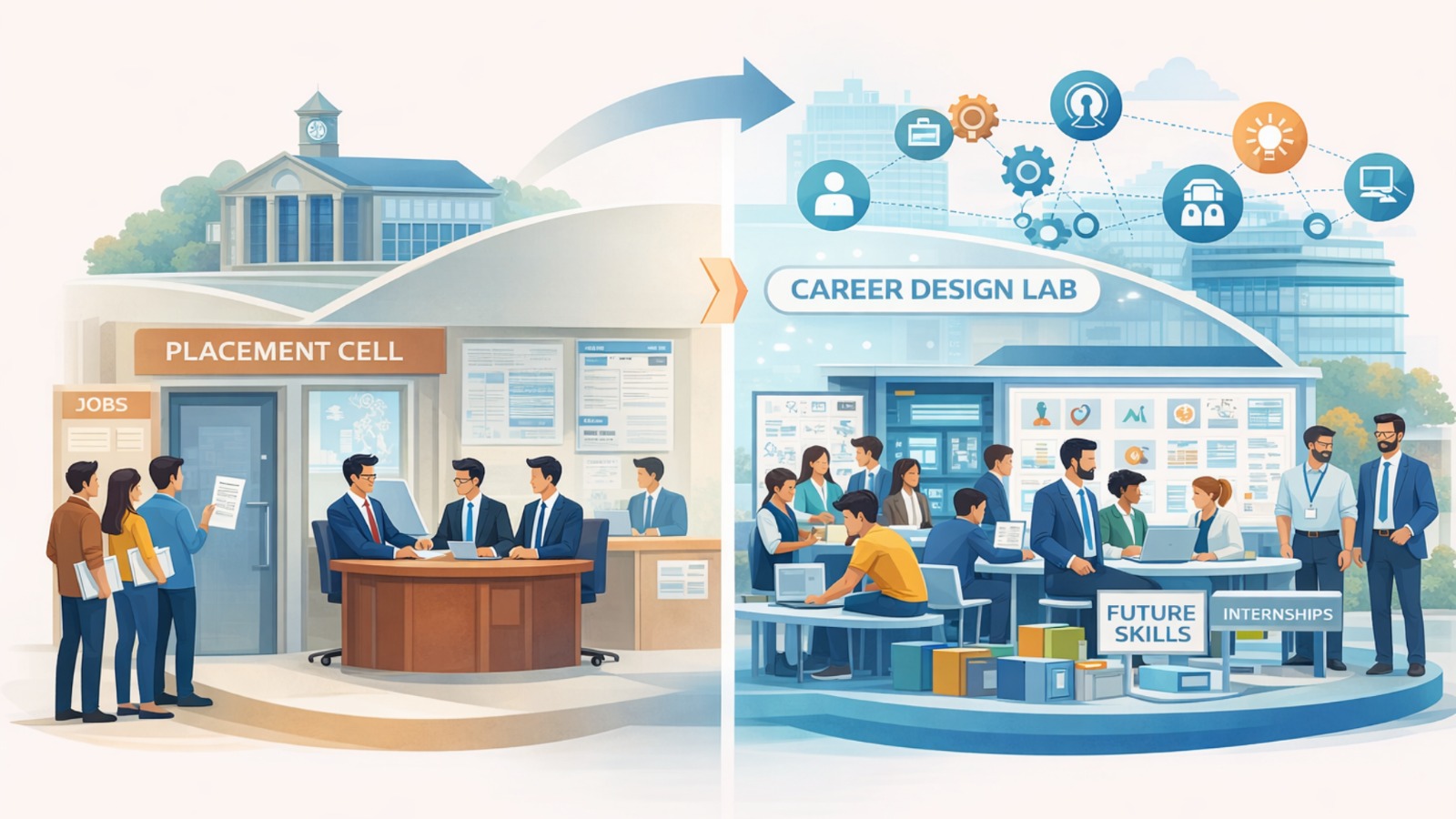
From ‘Placement Cells’ to ‘Career Design Labs’
Another significant shift is the reimagining of the Placement Cell. Historically, these were transactional hubs — offices that coordinated interview dates. Under the new leadership narrative, aligned with NEP’s focus on skill acquisition, these are becoming “Career Design Labs.” Here, industry feedback loops are instant. If a recruiter tells the university, “Your students are great at coding but terrible at business communication,” the agile leadership immediately introduces a credit course to fix that gap. The feedback loop between Industry (Reality) and Academia (Preparation) is becoming instantaneous.
Challenges and Opportunities
Funding constraints, faculty readiness, intellectual property negotiations, and bureaucratic inertia can slow down implementation. Yet, these challenges are also opportunities for creative leadership. Strategic alliances, industry-sponsored research labs, innovation incubators, and government-industry-academia consortia can address resource gaps. The pandemic has further taught institutions the value of agility — remote collaboration, virtual internships, and digital research platforms have expanded possibilities for industry-academia engagement.
Conclusion
The journey is ongoing, but the destination is clear: a higher education system that is flexible, globally aligned, industry-integrated, and capable of translating research into tangible reality. By bridging policy, leadership, and institutional practice, India can nurture a generation of thinkers and doers who are not just academically accomplished but practically impactful — a generation ready to redefine the future of education, industry, and society.
Key Insights
- Leadership is the critical bridge between NEP 2020 policy intent and institutional practice.
- Industry–academia collaboration has shifted from optional to imperative for relevance and impact.
- Applied and experiential research is replacing siloed, publication-only academic research.
- Cultural change within institutions is as important as structural reforms.
About the Author
Dr. Sreejith Vignesh B P completed his Ph.D. in Computer Science from Bharathiar University, along with M.Sc. Software Engineering, MCA, MBA (HR & Systems), M.Phil., and a PG Diploma in Labour Law and Administrative Law. He is a Cisco Certified Network Associate with Oracle certifications and has received 22 Awards/Recognitions, including Best Techno Faculty Award by ICT Academy and Best Young Researcher Award from the Association of Scientists, Developers and Faculties. He currently serves as Associate Professor and Head, Department of Information Technology, Sri Krishna Adithya College of Arts and Science, Coimbatore.