
Table of Contents

How NEP 2020 is bridging India’s ancient knowledge heritage with the age of Artificial Intelligence — and why the world is watching.
Education · Artificial Intelligence · Indian Knowledge Systems
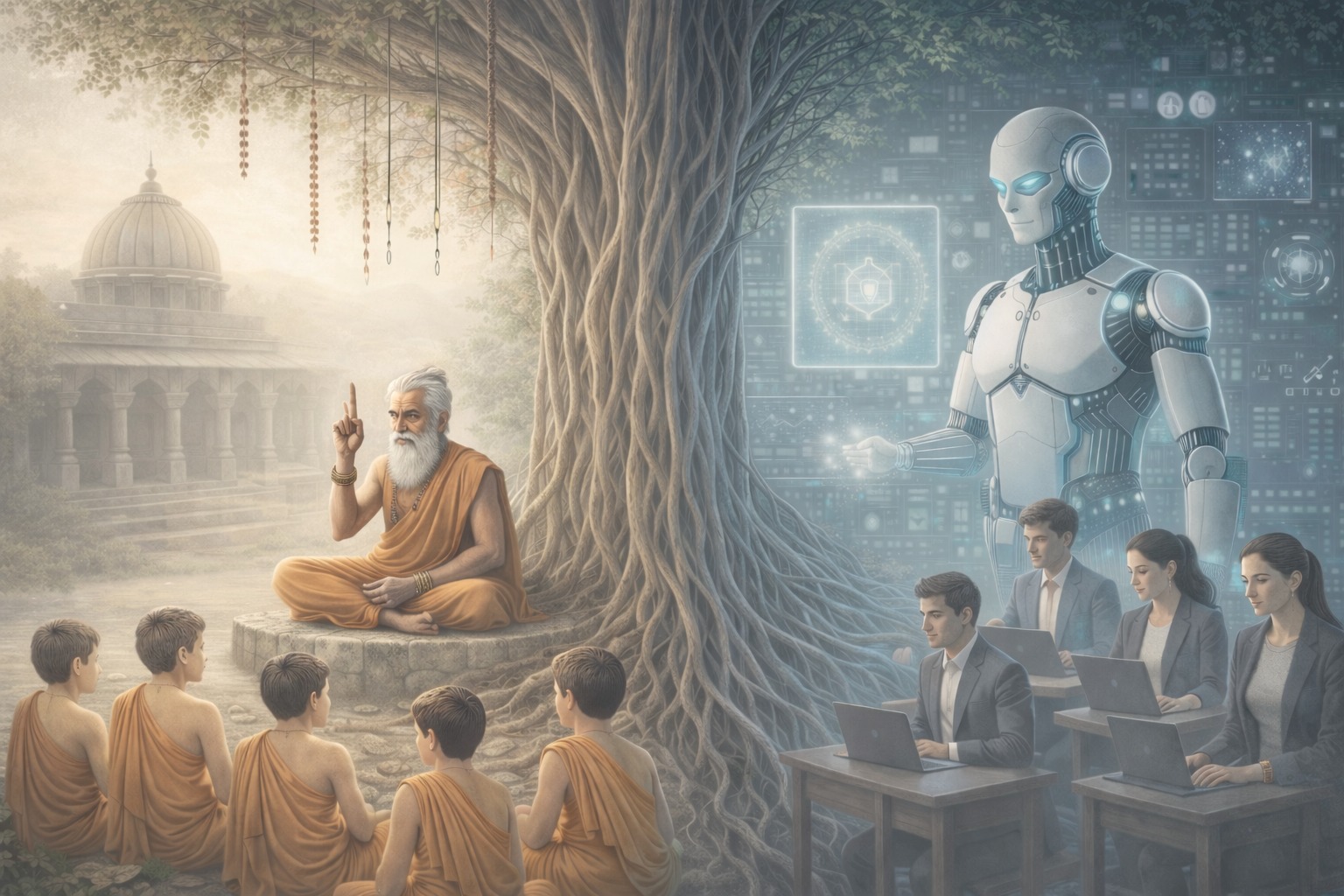
What do the ancient forests of a gurukul and the neural networks of a large language model have in common? More than we might expect. Both are built on the belief that knowledge, properly transmitted, can transform the human being who receives it. The question facing India today is not whether to choose between its intellectual heritage and the digital future — it is how to make them speak to each other.
India’s National Education Policy 2020 is the most ambitious attempt yet to answer that question. For the first time in the country’s post-independence history, a national policy explicitly positions Indian Knowledge Systems (IKS) — from Vedic philosophy to Ayurveda, from Panini’s grammar to traditional environmental sciences — at the centre of the educational ecosystem. And it does so in the same breath as calling for the ethical integration of Generative AI into the learning process. This is not mere symbolism. It is a structural and philosophical reorientation that carries profound implications for how India educates its citizens, preserves its intellectual heritage, and positions itself in a world increasingly shaped by artificial intelligence.
A Living Tradition, Interrupted
The gurukul was never simply a school. It was an ecosystem — one where the guru-disciple relationship, immersive daily life, and disciplines ranging from ethics to astronomy created what we might today call holistic education. Concepts like dharma (ethical conduct), karma (duty in action), tapas (self-discipline), and svādhyāya (deep self-inquiry) were not subjects to be studied but orientations to be embodied. Indian Knowledge Systems encompassed Panini’s Ashtadhyayi — one of the most sophisticated works of formal grammar ever composed — as well as the decimal system, the concept of zero, Ayurveda, and the surgical texts of the Sushruta Samhita. Colonial educational policy, most famously articulated in Macaulay’s 1835 Minute on Indian Education, systematically displaced these epistemologies in favour of English-medium Westernised curricula — marginalising indigenous languages, eroding traditional pedagogies, and teaching generations of learners to view their own intellectual inheritance as secondary.
” The real promise lies not merely in technological adoption but in integrating values, wisdom traditions, and creative inquiry into future learning ecosystems. “
NEP 2020: Recentring the Indigenous
The National Education Policy 2020 marks a genuine inflection point. By explicitly advocating for mother-tongue instruction in early years, interdisciplinary learning, and the formal inclusion of IKS domains in curricula, it signals a decisive departure from the colonial inheritance. Cultural self-confidence and contextual relevance — long treated as incompatible with academic rigour — are now policy imperatives. Knowledge systems are not merely repositories of information; they are ways of seeing. An education that excludes indigenous epistemologies does not simply leave out content; it shapes graduates who are epistemically alienated from the societies they are meant to serve. NEP 2020’s insistence on IKS integration is, at its core, a project of epistemic restoration.
Where Ancient Wisdom Meets Generative AI
Generative AI — systems capable of producing text, images, translations, and interactive learning experiences — offers tools that were unimaginable even a decade ago, many of them directly applicable to the IKS revival NEP 2020 envisions. AI-powered language models can translate ancient Sanskrit manuscripts, making texts accessible to students across India and the world. Semantic search technologies can index vast collections of vernacular oral traditions. Interactive AI modules can reconstruct traditional mathematical reasoning and present it through modern pedagogical interfaces. NEP 2020 recognises this potential, mandating the creation of a National Educational Technology Forum (NETF) to guide the ethical and equitable integration of technology in education. Generative AI, within this framework, becomes not a replacement for the guru but a new kind of medium — one that can carry indigenous knowledge further, faster, and to more learners than any previous technology.
The Challenges Cannot Be Wished Away
The vision is compelling. The obstacles are real. Generative AI models are trained predominantly on Western-language digital content; when applied to indigenous knowledge systems, they risk misrepresentation or distortion. Culturally accurate AI requires community-driven data governance — the communities whose knowledge is being encoded must have agency in how it is represented. The digital divide poses an equally urgent challenge: NEP 2020’s vision reaches its full potential only if rural and marginalised communities have reliable connectivity and digital access. Without targeted infrastructure investment, the policy risks deepening existing inequalities. Finally, pedagogical readiness demands that educators be equipped not just to use AI tools but to use them wisely — maintaining the human mentorship, critical inquiry, and ethical reasoning that no algorithm can substitute. As one framing of the policy makes clear: technology must complement — not replace — contextual learning, critical inquiry, and ethical reasoning. The educator’s role does not diminish; it evolves.
A Global Movement India Can Lead
India is not alone in grappling with the relationship between indigenous knowledge and modern technology — but it may be uniquely positioned to lead. Australia has integrated Aboriginal knowledge into education through place-based learning and digital language documentation. New Zealand’s curriculum formally incorporates mātauranga Māori using AR and VR to visualise oral histories and ecological understanding. Canadian First Nations communities have built AI partnerships grounded in indigenous data sovereignty. These international examples share a common principle: technology must complement indigenous pedagogies, not consume them. India, with its vast IKS heritage, its growing AI research capacity, and the structural mandate of NEP 2020, is positioned to develop models with genuine global relevance. The journey from the gurukul’s shaded courtyard to the era of Generative AI is not a rupture — it is an evolution. The measure of its success will not be in the sophistication of the AI tools deployed, but in whether the wisdom of the ancients reaches the students who need it most — and in whether those students are empowered to carry it forward.
References
Barton, D., & Tan, E. (2019). Language and digital literacy in indigenous education. Cambridge University Press.
Government of India. (2020). National Education Policy 2020. Ministry of Education. https://www.education.gov.in
Kukutai, T., & Taylor, J. (2016). Indigenous data sovereignty: Towards an agenda. ANU Press.
Luckin, R., Holmes, W., Griffiths, M., &Forcier, L. (2016). Intelligence unleashed: An argument for AI in education. Pearson.
Smith, L. T. (2012). Decolonizing methodologies: Research and indigenous peoples. Zed Books.
UNESCO. (2021). AI and education: Guidance for policy-makers. UNESCO.
About the Author
Prof. (Dr.) Aradhana Parmar is a distinguished academic and researcher specialising in education reform, Indian Knowledge Systems, and the integration of technology in learning. With a scholarly focus on the intersection of indigenous epistemologies and contemporary pedagogy, her work critically examines how national education frameworks, particularly NEP 2020, can bridge cultural heritage with modern innovation. She is a published author and speaker across education policy, Generative AI in pedagogy, and interdisciplinary curriculum design, bringing a comparative global perspective to India’s educational transformation.